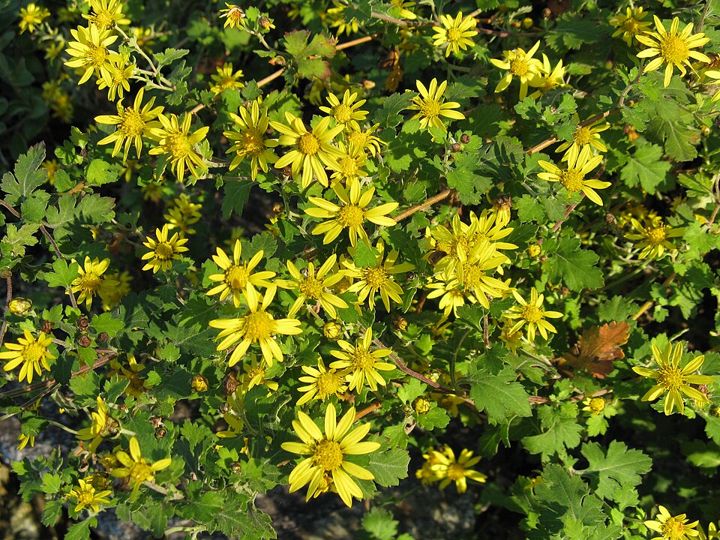
A perennial herb up to 1 m tall and 0.6 m across. Ovate leaves shallowly to deeply pinnately lobed with toothed edges, aromatic. Heads about 1.5–2.5 cm across with yellow (rarely white) rays and yellow disc florets, like miniature chrysanthemums, crowded in corymbs. The type species of the genus and one of the wild parents of the garden chrysanthemum; variable across habitats and hybridising with Chrysanthemum lavandulifolium. Stems and leaves are eaten in Nanjing as a summer vegetable.
Habitat
Hill grassland, roadsides, field banks, river banks and rock crevices, in sun with moist soil, tolerating any soil type; one of the commonest yellow flowers of autumn fields.
Distribution
Native to most of China, Korea, Japan and north-east India; very common throughout China and present from Honshu south in Japan. Absent from Singapore.
Season and behaviour
August to November, peaking in October and November and still flowering after frost; wild chrysanthemums come with the red leaves.
Photography tips
These are the FilmAnalysis editors' notes, not content from the sources.
Clumps of small yellow heads compress from a little distance with a long lens against dark rock or autumn leaves; a single head wants a head-on macro of the even rays. Yellow clips at noon, and low evening light is best. Ice crystals on the petals on a frosty morning are a late-autumn subject.
Photographic styles
Small yellow daisies of autumn fields; frosty-morning macro.
Similar species
Chrysanthemum lavandulifolium (smaller denser heads, more deeply cut leaves); garden chrysanthemum (far larger flowers); other yellow composites such as sowthistles (different head structure).
Related badge
The album badge "a chrysanthemum" unlocks when the vision model explicitly names a a chrysanthemum in your photo and you rate the analysis. The badge stops at "a chrysanthemum": it does not tell species apart, and this page existing unlocks nothing.
The illustration is original FilmAnalysis artwork. The photograph is from Wikimedia Commons; its licence and author are under it.
Why it is listed: this species comes from the Flower checklist (GBIF backbone and Wikidata verified). Names follow the GBIF backbone and Wikidata; the facts follow the sources below; photo recognition is not offered.