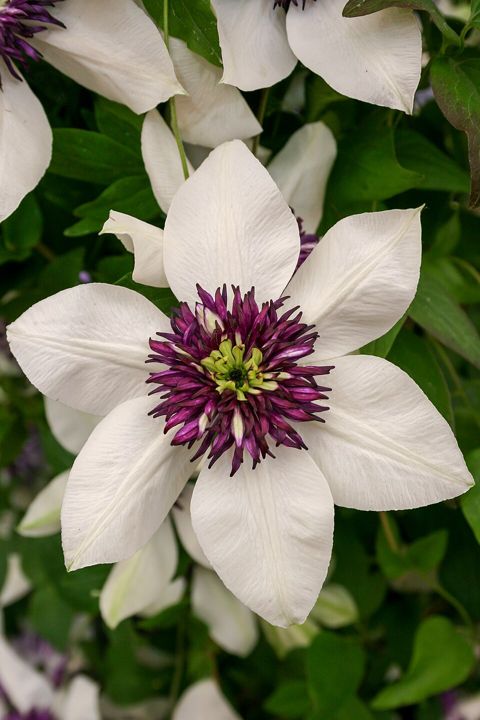
A woody climber clinging by its leaf stalks, the wiry stems giving the Chinese name iron-wire lotus. Twice-ternate leaves. Solitary axillary flowers 5–8 cm across with six white or cream sepals (no petals) spread flat like a saucer round a boss of purple-black stamens, a strong contrast; in the cultivated double and 'Sieboldii' forms the stamens become a purple centre like a passion flower, hence the English name.
Habitat
Scrub, thicket edges and streamsides at about 1,700 m; in gardens it climbs fences and trellises. Long grown in Korea and Japan after introduction from China.
Distribution
Native to southern China: Guangdong, northern Guangxi, Hubei, Hunan, western Jiangxi, south-western Yunnan and Zhejiang; cultivated in Japan since early times (tessen, a staple of summer kimono patterns) and a parent of many garden clematis. Absent from Singapore.
Season and behaviour
May and June, May in Japan; the large-flowered garden forms from May to July, some repeating in autumn.
Photography tips
These are the FilmAnalysis editors' notes, not content from the sources.
The flat flower seen straight down is most graphic, and the contrast of white sepals and purple-black stamens is harsh except in soft light; macro for the centre of the double forms. A climber's flowers face the light, so find the angle along their gaze. Dark green or a wooden fence behind.
Photographic styles
Saucer-shaped white flowers from above; the contrast of a purple-black centre.
Similar species
Clematis patens (larger, eight sepals, the other parent of Japanese garden clematis); the large-flowered hybrids; Clematis chinensis (many small white flowers).
Related badge
None yet. No validated photo recognition exists for this species, so no badge is tied to it: a name in the encyclopedia is not evidence in a photograph.
The illustration is original FilmAnalysis artwork. The photograph is from Wikimedia Commons; its licence and author are under it.
Why it is listed: this species comes from the Flower checklist (GBIF backbone and Wikidata verified). Names follow the GBIF backbone and Wikidata; the facts follow the sources below; photo recognition is not offered.