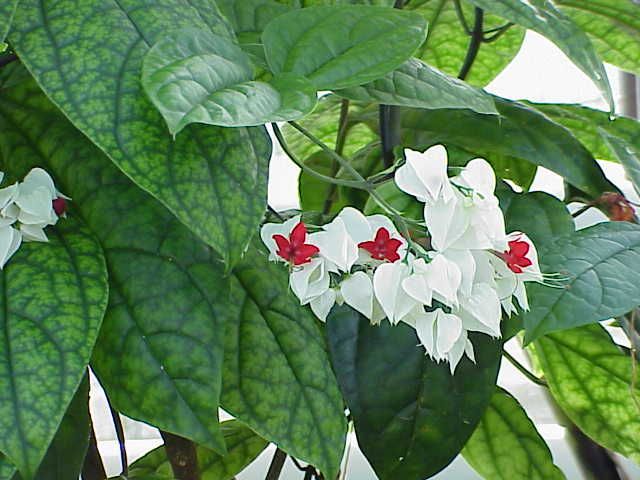
An evergreen liana to 4 m with ovate to oblong leaves 8–17 cm. Flowers in cymes of eight to twenty, each with a pure white to pale purple five-lobed calyx like a lantern or heart-shaped bag 2.5 cm across, from which a red five-lobed corolla 2 cm long and wide emerges with far-projecting stamens, the red flower spat from the white calyx, hence the Chinese name dragon spitting a pearl. After flowering the white calyx turns pale purple and persists for weeks.
Habitat
Tropical pergolas, fences and balcony pots in bright diffuse light and moisture; a common ornamental climber and glasshouse plant in East Asia.
Distribution
Native to tropical West Africa from Cameroon to Senegal; common in Singapore's gardens and parks, grown in southern China and Taiwan, and a glasshouse pot plant in the north and in Japan.
Season and behaviour
Flowers all year in the tropics, mainly in the rains in Singapore; May to November in southern China. The white calyces persist for weeks, so the cymes look good for a long time.
Photography tips
These are the FilmAnalysis editors' notes, not content from the sources.
White calyx and spat-out red flower are a ready contrast, a cluster in soft light, half a stop under for the calyx without letting the red bleed; a head-on macro for the red corolla and long stamens. Against the light the white calyces turn translucent like paper lanterns. Dark green leaves behind.
Photographic styles
Red flowers spat from white lanterns; translucent calyces against the light.
Similar species
Clerodendrum × speciosum (pink calyces); pagoda flower (red flowers and calyces, a shrub); Clerodendrum bungei (pink flowers in balls).
Related badge
None yet. No validated photo recognition exists for this species, so no badge is tied to it: a name in the encyclopedia is not evidence in a photograph.
The illustration is original FilmAnalysis artwork. The photograph is from Wikimedia Commons; its licence and author are under it.
Why it is listed: this species comes from the Flower checklist (GBIF backbone and Wikidata verified). Names follow the GBIF backbone and Wikidata; the facts follow the sources below; photo recognition is not offered.