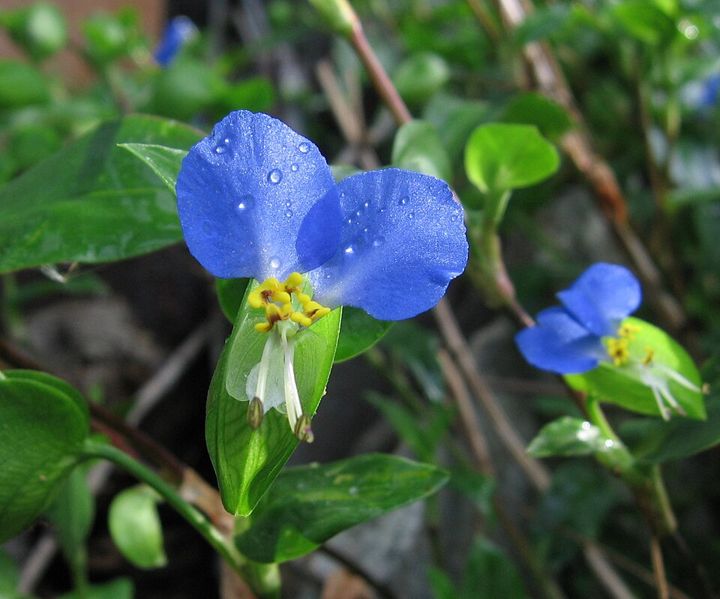
An annual herb with stems prostrate at the base and erect towards the tips, rooting at the lower nodes. Sessile or nearly sessile narrow lance-shaped leaves. Flowers of two larger bright blue petals and one tiny white one emerging from a folded heart-shaped bract, like small blue butterflies; each lasts a single day, hence the English name. Called dew herb in Japanese and once used for dyeing; first recorded in the Man'yōshū of the fourth to eighth centuries.
Habitat
Shady roadsides, field edges, ditches, forest edge and the damp half-shade of gardens; a very common weed.
Distribution
Native to most of China east of Sichuan, Yunnan and Gansu, Taiwan, Korea, the Russian Far East, Japan and Vietnam; introduced to central and south-eastern Europe and eastern North America as a weed. Very common in China and Japan; absent from Singapore.
Season and behaviour
Flowers from June to October, opening at dawn and withering around midday, so rise early.
Photography tips
These are the FilmAnalysis editors' notes, not content from the sources.
The blue petals are most saturated in soft early light, and the flower wilts once the sun is high; a head-on or three-quarter macro shows both blue petals and the yellow anthers. Dark shaded ground behind sets off the blue. A dewy dawn is its whole window.
Photographic styles
Small blue flowers in morning dew; translucent macro.
None yet. No validated photo recognition exists for this species, so no badge is tied to it: a name in the encyclopedia is not evidence in a photograph.
The illustration is original FilmAnalysis artwork. The photograph is from Wikimedia Commons; its licence and author are under it.
Why it is listed: this species comes from the Flower checklist (GBIF backbone and Wikidata verified). Names follow the GBIF backbone and Wikidata; the facts follow the sources below; photo recognition is not offered.