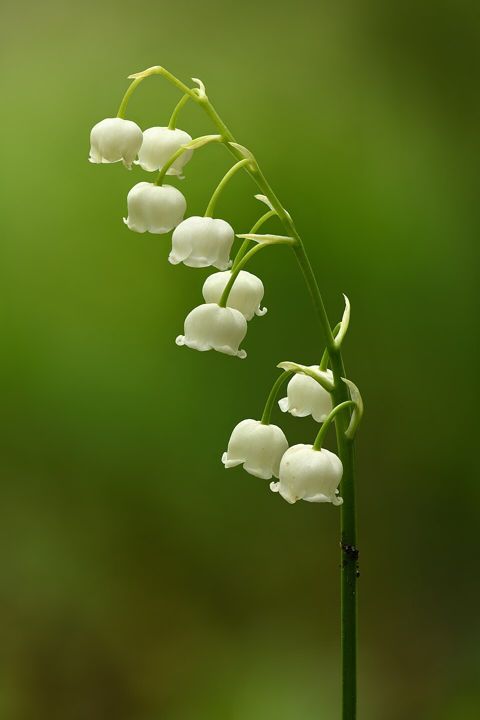
A herbaceous perennial spreading by rhizomes into extensive colonies. Stems 15–35 cm with two (rarely three) leaves 5–20 cm long and 3–7 cm wide. A one-sided raceme of six to twelve pendent flowers on the upper stem, six white tepals fused at the base into a bell with reflexed tips, 5–10 mm across, sweetly scented; small orange-red berries. The whole plant is highly poisonous. The former East Asian variety keiskei is now the separate species Convallaria keiskei, so the wild lily of the valley of north-east China and Japan is strictly that relative.
Habitat
Woodland, forest edge and shaded moist hillsides at 850–2,500 m; widely planted in shady garden corners, and in France given on the first of May (the song Le temps du muguet).
Distribution
Native to Europe, western and northern Asia; the East Asian wild populations (north-east and northern China, northern Japan) are now Convallaria keiskei, but all are called lily of the valley in gardens, widely grown across China and in Hokkaido. Absent from Singapore.
Season and behaviour
Late April to early June, May in the north; about two weeks, with the spiraeas and peonies.
Photography tips
These are the FilmAnalysis editors' notes, not content from the sources.
The small bells hang hidden between two big leaves, so get down to the ground with a macro, from the side or slightly below to see into the bell; half a stop under for white, with shaded dark green behind. At dawn a drop of dew collects inside the bell. Poisonous throughout, so keep children's hands off it afterwards.
Photographic styles
Small white bells hanging between leaves; low-angle macro.
Similar species
Convallaria keiskei (slightly larger flowers, broader leaves, wild in the north-east and Japan); false Solomon's seal (many small flowers, not bell-shaped); Solomon's seal (axillary greenish-white flowers in pairs).
Related badge
None yet. No validated photo recognition exists for this species, so no badge is tied to it: a name in the encyclopedia is not evidence in a photograph.
The illustration is original FilmAnalysis artwork. The photograph is from Wikimedia Commons; its licence and author are under it.
Why it is listed: this species comes from the Flower checklist (GBIF backbone and Wikidata verified). Names follow the GBIF backbone and Wikidata; the facts follow the sources below; photo recognition is not offered.