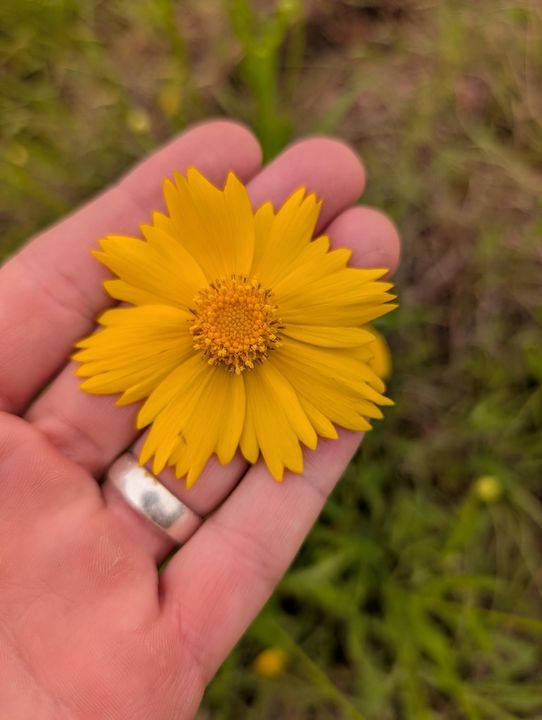
Photo: Nautilus 211, via iNaturalist, public domain / CC0. Unmodified apart from resizing.
Colour
yellow
Region
Japan and temperate East Asia
Season
summer
Shape
single flower
Identification
A North American perennial sometimes over 60 cm, with opposite leaves, the lower spoon-shaped and the upper pinnately cut into linear lobes. Golden heads whose rays and disc are both yellow, the rays toothed at the tip, 4–6 cm across, solitary on long slender stalks that sway in wind. The epithet means large-flowered. Widely cultivated and naturalised in China, a regular of roadsides and slope plantings.
Habitat
Roadsides, waste ground, embankments and borders, tolerant of drought and poor soil and self-seeding freely; on sand and rocky slopes at home.
Distribution
Native to eastern Canada (Quebec, Ontario, New Brunswick) and much of the United States, especially the south-central states (Oklahoma, Arkansas); grown and naturalised across China (common on roadsides in Jiangxi, eastern and northern China), grown and escaped in Japanese beds and verges (ō-kinkeigiku), absent from Singapore.
Season and behaviour
May to September, peaking June and July; continuous, each flower lasting about a week.
Photography tips
These are the FilmAnalysis editors' notes, not content from the sources.
An all-yellow flower blows out fastest in sun: a stop under to keep the toothed ray tips, fullest colour under cloud. The slender stalks sway, so 1/1000 s, or a deliberate slow shutter for movement. Sheets of yellow from low and wide so the flowers stand against the sky. Macro from above for the toothed rays.
Photographic styles
Yellow flowers swaying in wind; a yellow field from low down.
Similar species
Lanceleaf tickseed, Coreopsis lanceolata (unlobed lanceolate leaves, more often escaped, the two often confused); plains coreopsis (annual, red-brown eye); black-eyed Susan (black disc).
Related badge
None yet. No validated photo recognition exists for this species, so no badge is tied to it: a name in the encyclopedia is not evidence in a photograph.
The illustration is original FilmAnalysis artwork. The photograph is from iNaturalist; its licence and author are under it.
Why it is listed: this species comes from the Flower checklist (GBIF backbone and Wikidata verified). Names follow the GBIF backbone and Wikidata; the facts follow the sources below; photo recognition is not offered.