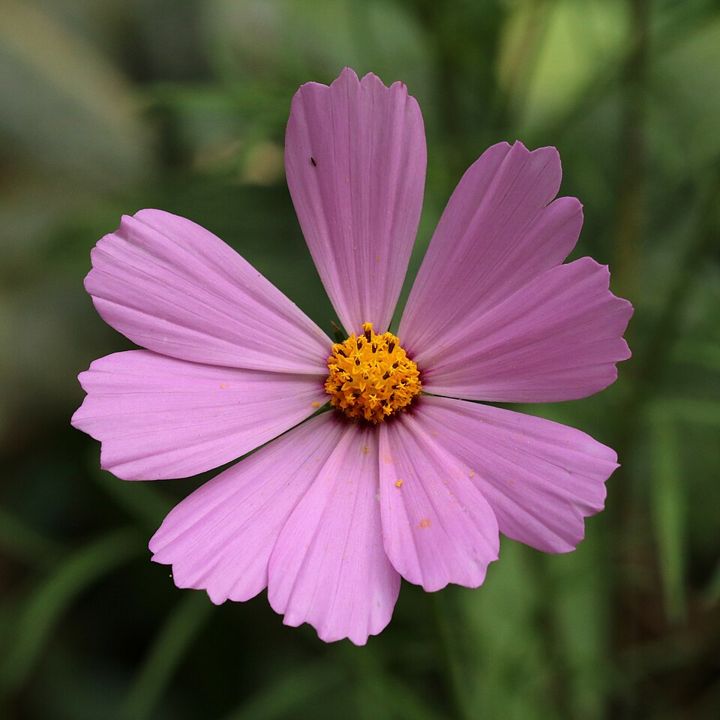
An annual often considered half-hardy, self-sowing for years; 60 cm to 2 m tall, rarely 2.75 m. Opposite leaves twice pinnately cut into thread-like segments 0.5–1 mm wide. Heads 5–8 cm across with eight ray florets in pink, white or magenta round a yellow disc; countless cultivars. Branched stems usually with rough hairs, top-heavy in flower, so they are grown in groups that hold each other up. Called autumn cherry in Japanese.
Habitat
Beds, borders, roadsides and park flower fields in full sun, intolerant of half shade, moderately hardy to cold and heat; native to the Mexican plateau at 1,600–2,800 m. Prolific, often forming seas of flowers.
Distribution
Native to the Americas (Mexico); widely grown and escaped across China, common throughout Japan (the autumn fields and songs of kosumosu), and hard to grow in Singapore's heat.
Season and behaviour
July to November, peaking in September and October as the Japanese name promises; a field lasts over a month.
Photography tips
These are the FilmAnalysis editors' notes, not content from the sources.
The thin stems sway in wind, so 1/1000 s or faster; against the light the pink petals glow and the thread-like leaves become a halo, its finest light. Compress a field's density with a long lens and a blurred foreground; a single head in head-on macro for the toothed rays and yellow centre. Low autumn evening light is best.
Photographic styles
A backlit sea of pink; the halo of thread-like leaves.
None yet. No validated photo recognition exists for this species, so no badge is tied to it: a name in the encyclopedia is not evidence in a photograph.
The illustration is original FilmAnalysis artwork. The photograph is from Wikimedia Commons; its licence and author are under it.
Why it is listed: this species comes from the Flower checklist (GBIF backbone and Wikidata verified). Names follow the GBIF backbone and Wikidata; the facts follow the sources below; photo recognition is not offered.