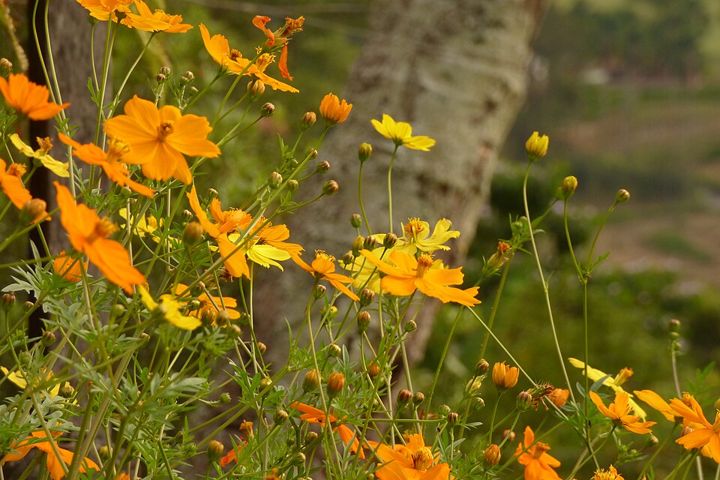
Photo: Alejandro Bayer Tamayo from Armenia, Colombia, via Wikimedia Commons, licensed CC BY-SA 2.0. Unmodified apart from resizing.
Colour
yellow, orange
Region
Japan and temperate East Asia, Singapore and tropical Asia
Season
summer, autumn
Shape
single flower
Identification
A half-hardy annual 30–210 cm tall that may self-sow for years. Opposite pinnately divided leaves with broader segments than the garden cosmos. Sulphur-yellow to orange heads with eight toothed ray florets, double and deep orange-red in cultivars. Untidy in habit, best in masses. Arose by natural hybridisation of Cosmos bipinnatus with other species and reached Asia from Mexico on the Manila–Acapulco galleons. Declared invasive in the south-eastern United States in 1996. The flowers attract birds and butterflies.
Habitat
Roadsides, beds, waste ground and park flower fields in sun or half shade; grows naturally below 1,600 m.
Distribution
Native to Mexico, Central America and northern South America and naturalised in the Americas, Europe, Asia and Australia; grown in flower fields and escaped across China, common throughout Japan (autumn fields of yellow cosmos), and grown in Singapore.
Season and behaviour
June to November, most in autumn; a flower field lasts about two months.
Photography tips
These are the FilmAnalysis editors' notes, not content from the sources.
Orange-yellow is most luminous against the light, and low evening sun turns a whole field gold; compress the density with a long lens, or go wide and low to take in the sky. A single flower head-on in macro for the eight toothed rays. Butterflies and bees at 1/1600 s.
Photographic styles
Backlit golden fields; the head-on graphic of one flower.
None yet. No validated photo recognition exists for this species, so no badge is tied to it: a name in the encyclopedia is not evidence in a photograph.
The illustration is original FilmAnalysis artwork. The photograph is from Wikimedia Commons; its licence and author are under it.
Why it is listed: this species comes from the Flower checklist (GBIF backbone and Wikidata verified). Names follow the GBIF backbone and Wikidata; the facts follow the sources below; photo recognition is not offered.