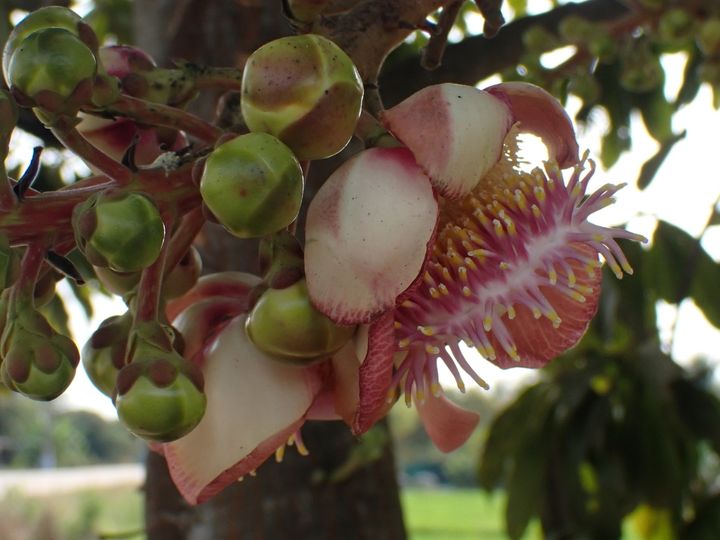
Photo: Robert H. Wardell, via iNaturalist, public domain / CC0. Unmodified apart from resizing.
Colour
pink, red, yellow
Region
Singapore and tropical Asia
Season
year-round
Shape
hanging raceme
IUCN status
Least Concern
Identification
A deciduous tree up to 35 m. Leaves clustered at the branch tips, usually 8–31 cm and up to 57 cm. Inflorescences grow straight from the trunk (cauliflory), long hanging racemes that can cover the whole trunk; large strongly scented flowers with six fleshy petals yellow outside and pink to deep red within, and stamens in two sets, a ring of fertile stamens and a hood of sterile ones curving over them. The fruit is a brownish-grey ball up to 25 cm across hanging on the trunk like a cannonball, hence the name; the pulp smells foul as it ferments. Planted at Hindu temples as a sacred tree.
Habitat
Tropical lowland rainforest; a curiosity tree in tropical botanic gardens, parks and temples, kept back from paths because falling fruit is dangerous.
Distribution
Native to the lowland rainforests of Central and South America (Costa Rica to Brazil and northern Bolivia) and widely grown in the tropics; large trees in the Singapore Botanic Gardens and several parks, grown in botanic gardens in southern China (Hainan, Guangdong, Yunnan), glasshouse-only in Japan.
Season and behaviour
Flowers and fruit all year in the tropics, both hanging on the trunk at once; each flower lasts one day, opening at dawn and falling by evening.
Photography tips
These are the FilmAnalysis editors' notes, not content from the sources.
Cauliflory is the whole subject: a trunk hung with drooping racemes and rows of cannonballs at once, a portrait frame of one stretch of trunk at eye level. The stamen hood wants a head-on macro, the yellow-outside pink-inside petals side light. Fallen flowers carpet the ground below, from low. Do not stand under the fruit.
Photographic styles
A trunk hung with flowers and cannonballs; macro of the stamen hood.
Similar species
Barringtonia (also night-opening with thread stamens, but different fruit); baobab (large fruit, not on the trunk); no other common tree looks like it.
Related badge
None yet. No validated photo recognition exists for this species, so no badge is tied to it: a name in the encyclopedia is not evidence in a photograph.
The illustration is original FilmAnalysis artwork. The photograph is from iNaturalist; its licence and author are under it.
Why it is listed: this species comes from the Flower checklist (GBIF backbone and Wikidata verified). Names follow the GBIF backbone and Wikidata; the facts follow the sources below; photo recognition is not offered.