Singapore and tropical Asia, Japan and temperate East Asia
Season
summer
Shape
cluster
Identification
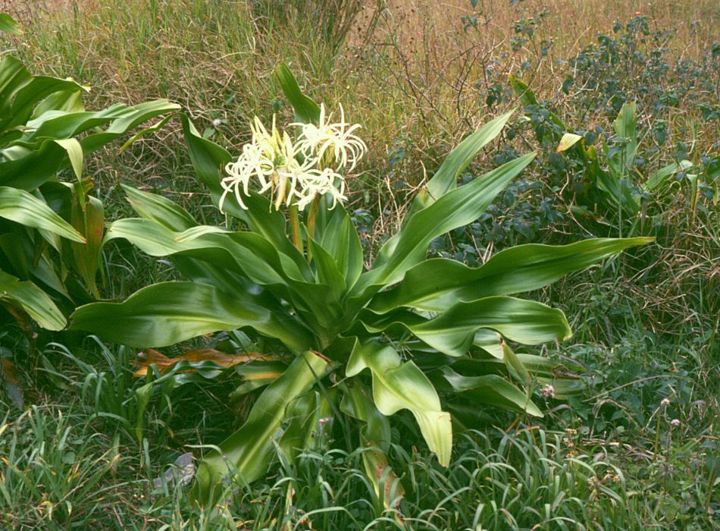
A perennial herb up to 1.2 m with a spherical bulb cylindrical above, 6–15 cm across. 20–30 lanceolate leaves with undulate margins, dark green, up to 1 m long and 7–12 cm or more wide. An erect scape as long as the leaves carries an umbel of 10–24 fragrant flowers; the perianth tube slender and straight, green-white, 7–10 cm; six linear, revolute white tepals 4.5–9 cm long like a spider's legs. Called an orchid in Chinese but an amaryllid. All parts poisonous and the sap can irritate skin. A typical sea-drifted plant.
Habitat
Sand behind beaches, coastal scrub and estuaries, and widely planted in parks, gardens and roadside beds; salt- and drought-tolerant.
Distribution
Native to East Asia, tropical Asia, Australia, the Pacific islands and western India; wild on the coasts of southern China and Taiwan, very common in Singapore's parks and seafronts, and on the coasts of southern Kyushu and the Ryukyus.
Season and behaviour
Peak bloom from June to August, sporadic all year in the tropics; scent strongest at dusk and the night-opened flowers freshest.
Photography tips
These are the FilmAnalysis editors' notes, not content from the sources.
The slender recurved white tepals read like a line drawing against a dark background (shaded scrub or night sky) in side light, half a stop under for white. Take the whole umbel head-on and a single flower in profile for its curves. Crinums on the shore with sea and sky are the standard tropical-coast frame, best at dusk. Avoid the sap.
Photographic styles
Flowers like white lines; dusk on a tropical shore.
Similar species
Spider lilies, Hymenocallis (a membranous cup between the tepals), often confused under the same Chinese names; lilies (tepals not recurved into lines).
Related badge
None yet. No validated photo recognition exists for this species, so no badge is tied to it: a name in the encyclopedia is not evidence in a photograph.
The illustration is original FilmAnalysis artwork. The photograph is from Wikimedia Commons; its licence and author are under it.
Why it is listed: this species comes from the Flower checklist (GBIF backbone and Wikidata verified). Names follow the GBIF backbone and Wikidata; the facts follow the sources below; photo recognition is not offered.