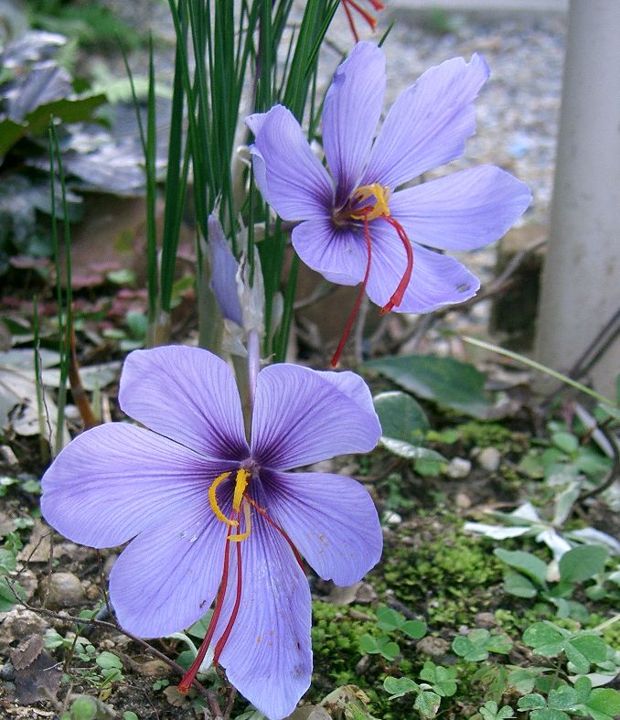
A perennial 10–30 cm tall whose leaves, bracts and flowering stalk rise from an underground corm. Simple linear leaves in a rosette. Purple flowers in autumn with six tepals and three red to orange stigmas that hang far out of the flower; the dried stigmas are the spice saffron, about 150,000 flowers to a kilogram, which makes it the costliest spice in the world. The flowers are sterile and the plant is propagated only by corms, unknown in the wild, a triploid cultigen probably descended from the Greek wild crocus. Cultivated and traded for over 3,500 years.
Habitat
Well-drained fields and beds, liking hot dry summers and cool winters; grown chiefly as a spice crop, also in autumn beds and pots.
Distribution
Of cultivated origin, with Iran, Kashmir, Spain and Greece the main producers; grown in Zhejiang, Chongming near Shanghai and Tibet in China (the Chinese name Tibetan red flower records its route through Tibet), in northern beds, and at Taketa in Ōita, Japan's saffron region, as well as in Japanese beds (safuran). Absent from Singapore.
Season and behaviour
October and November; each flower lasts two or three days and the stigmas are picked at dawn on the day it opens.
Photography tips
These are the FilmAnalysis editors' notes, not content from the sources.
Purple tepals with three orange-red stigmas spilling out are the whole picture: a head-on macro from above in soft light, purple truest under cloud and bluer in sun. The flowers hug the ground, so low at their level for the cup against autumn earth. Picking the flowers and stripping the stigmas by hand is a human subject, in the fields at dawn.
Photographic styles
Macro of purple tepals and orange-red stigmas; pickers in a dawn field.
Similar species
Meadow saffron, Colchicum autumnale (another family, six stamens and thin stigmas, deadly poisonous, often confused); spring-flowering garden crocuses (Crocus vernus and others, short stigmas); Crocus speciosus (autumn, blue-violet).
Related badge
None yet. No validated photo recognition exists for this species, so no badge is tied to it: a name in the encyclopedia is not evidence in a photograph.
The illustration is original FilmAnalysis artwork. The photograph is from Wikimedia Commons; its licence and author are under it.
Why it is listed: this species comes from the Flower checklist (GBIF backbone and Wikidata verified). Names follow the GBIF backbone and Wikidata; the facts follow the sources below; photo recognition is not offered.