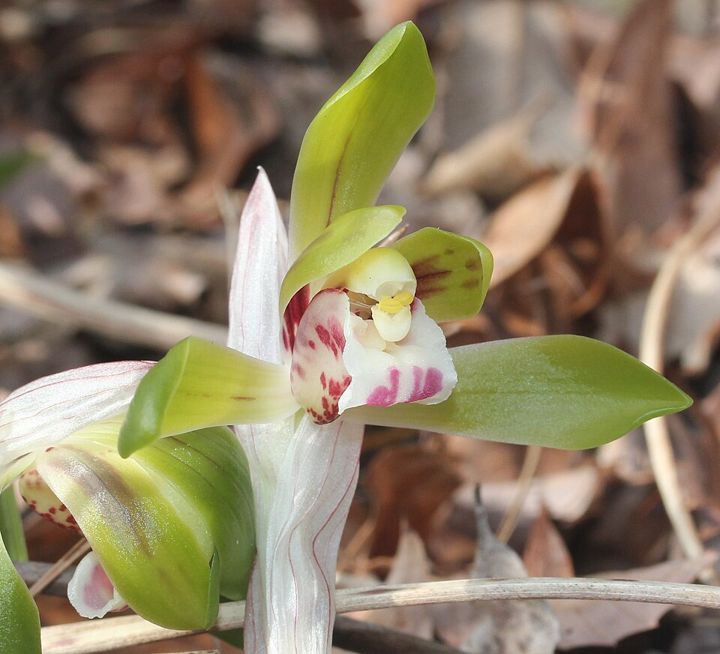
A terrestrial orchid, one of the Chinese guolan. Strap-shaped finely toothed leaves in clumps 20–60 cm long. An upright scape usually carrying one flower (rarely two), pale yellow-green with narrow sepals and petals and a white lip spotted purple-red, with a clear far-carrying fragrance that Chinese scholars have likened to virtue since antiquity. Variable in colour and petal form, the foundation species of Chinese and Japanese orchid culture with countless named forms.
Habitat
Stony hillsides, forest edge and light gaps in forest at 300–2,200 m, in clumps on humus-rich slopes.
Distribution
Southern Shaanxi and Gansu, the Yangtze provinces, southern and south-western China, Taiwan, Japan, Korea and north-east India; common in the hills of China and Japan but reduced by collecting. Absent from Singapore.
Season and behaviour
February to April, opening among dead leaves on the forest floor; from January in the south. Easier to find by scent than by eye.
Photography tips
These are the FilmAnalysis editors' notes, not content from the sources.
The flower is small, low and the colour of dead leaves and grass: lie on the ground with a macro and a dark background so the pale green floats out, the purple-red spots on the lip as focus. Weak diffuse forest light is exactly the softness it needs. Wild spring orchids are protected: look, leave, and never show a recognisable location.
Photographic styles
A point of pale green among dead leaves; the empty space of a scholar's painting.
Similar species
Cymbidium faberi (several flowers per scape, late spring); Cymbidium kanran (autumn and winter, narrower petals); Cymbidium ensifolium (summer and autumn, strong scent).
Related badge
None yet. No validated photo recognition exists for this species, so no badge is tied to it: a name in the encyclopedia is not evidence in a photograph.
The illustration is original FilmAnalysis artwork. The photograph is from Wikimedia Commons; its licence and author are under it.
Why it is listed: this species comes from the Flower checklist (GBIF backbone and Wikidata verified). Names follow the GBIF backbone and Wikidata; the facts follow the sources below; photo recognition is not offered.