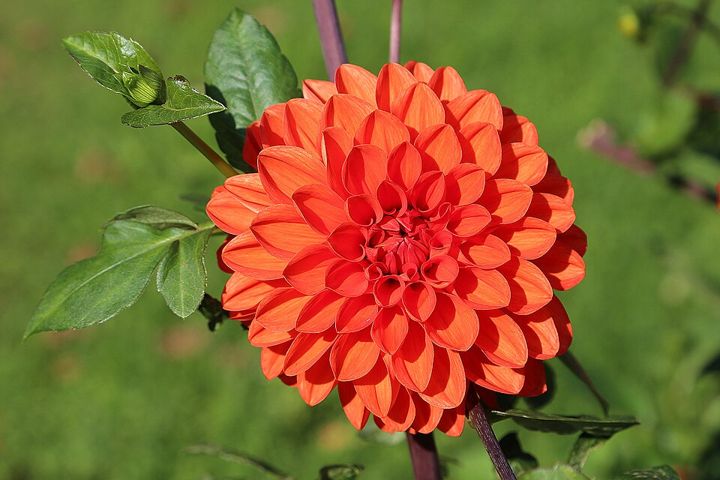
A perennial with a rhizome and tuberous roots, 70–120 cm tall, rarely 160 cm. Erect stems branched only in the inflorescence. Leaves usually pinnate with ovate leaflets 5–10 cm, slightly hairy. From July to October, two to eight heads 6–10 cm across (up to 30 cm in cultivars) on stalks 5–15 cm long, the wild type with eight pink to deep purple rays; tens of thousands of cultivars in decorative, cactus, pompon and other forms. The type species of the genus, the national flower of Mexico and the city flower of Zhangjiakou and Seattle.
Habitat
Beds, borders, cut-flower fields and gardens in sun and cool air, disliking great heat and frost; native to the mountains round Mexico City.
Distribution
Native to Mexico and widely grown through the temperate world; grown across China, best in the north and on the plateau (Zhangjiakou, Kunming), commonly grown in Japan (tenjiku-botan, the autumn dahlia gardens), hard in Singapore's heat.
Season and behaviour
July to October, peaking in August and September in the north and ending with frost; Japan's dahlia gardens are best in September and October.
Photography tips
These are the FilmAnalysis editors' notes, not content from the sources.
The layers of a big double flower have depth in soft light, while sun flattens the structure with highlights; a stop under for red and magenta. Straight down suits the geometry of pompon and decorative forms, the side the curled petals of cactus types. Heavy heads droop after rain, so a low viewpoint. In a garden, pick one flower from outside the bed with a long lens and blur the rest into colour.
Photographic styles
Soft-light geometry of layered flowers; blocks of colour in an autumn garden.
Similar species
Zinnia (annual, opposite clasping leaves, smaller); chrysanthemum (autumn, lobed leaves, different centre); tree peony (woody, spring).
Related badge
None yet. No validated photo recognition exists for this species, so no badge is tied to it: a name in the encyclopedia is not evidence in a photograph.
The illustration is original FilmAnalysis artwork. The photograph is from Wikimedia Commons; its licence and author are under it.
Why it is listed: this species comes from the Flower checklist (GBIF backbone and Wikidata verified). Names follow the GBIF backbone and Wikidata; the facts follow the sources below; photo recognition is not offered.