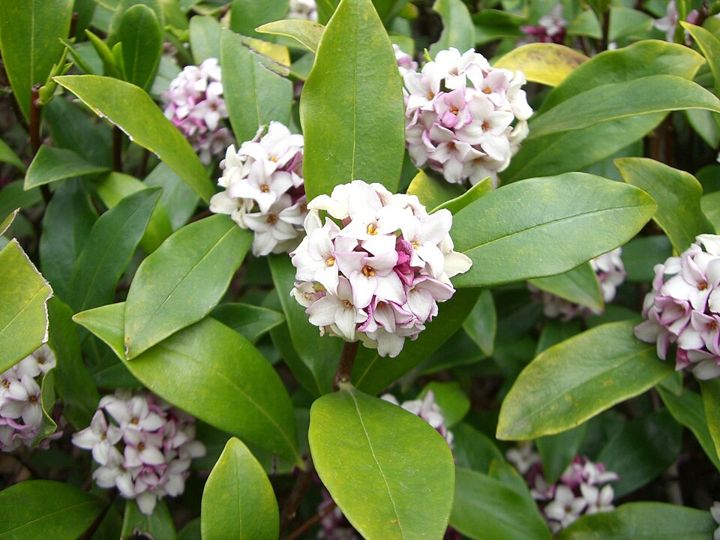
An evergreen shrub with glossy leathery leaves. Fleshy tubular flowers with four spreading lobes, purple-red outside and pale pink or white within, packed into terminal hemispherical heads so fragrant that Korea calls it the thousand-mile scent; it rarely fruits, occasionally producing red berries. The gold-edged variety is famed for the four perfections of colour, scent, form and grace and counted among the three treasures of world horticulture. The epithet means fragrant.
Habitat
Mountain forest floor and shaded damp slopes, more often in gardens, temples and pots; likes half shade and hates wet feet.
Distribution
Native to China south of the Yangtze and later spread to Japan and Korea; common in southern Chinese gardens and very widely grown in Japan (jinchōge, one of the three fragrant flowers of early spring). Absent from Singapore.
Season and behaviour
February and March, from the end of deep winter into early spring with the plum blossom; up to a month. The scent is heaviest at dusk and after light rain.
Photography tips
These are the FilmAnalysis editors' notes, not content from the sources.
The hemispherical head at eye level, the purple outside against the white inside clearest in soft light; macro for the four-lobed florets and unopened purple-red buds. The dark leathery leaves are a ready dark background, reflective in front light, so turn a little to the side. A flower of smell: a person smelling it carries the idea.
Photographic styles
Pink-white heads on dark green leaves; the scent of early spring.
Similar species
Oriental paperbush (yellow, deciduous, three-forked twigs); Daphne genkwa (pale purple, before the leaves, poisonous); the gold-edged daphne is a variety of this species.
Related badge
None yet. No validated photo recognition exists for this species, so no badge is tied to it: a name in the encyclopedia is not evidence in a photograph.
The illustration is original FilmAnalysis artwork. The photograph is from Wikimedia Commons; its licence and author are under it.
Why it is listed: this species comes from the Flower checklist (GBIF backbone and Wikidata verified). Names follow the GBIF backbone and Wikidata; the facts follow the sources below; photo recognition is not offered.