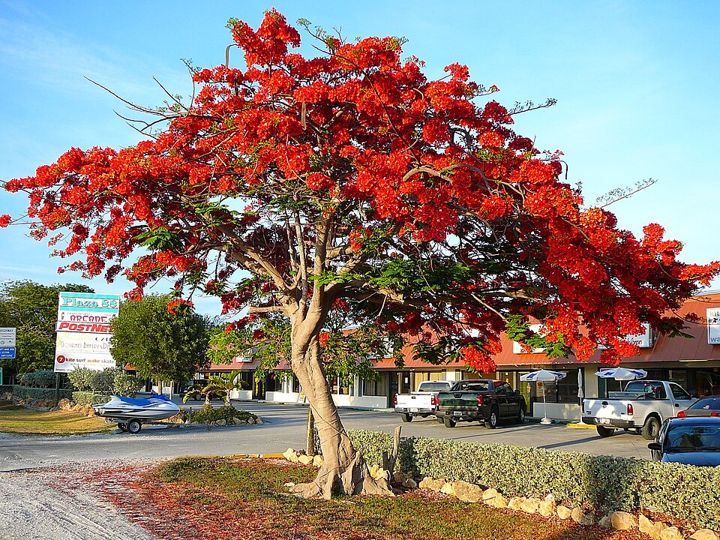
A medium-sized deciduous tree to about 10 m with a spreading umbrella crown and light brown bark with prominent lenticels. Fern-like bipinnate leaves with 8–25 or more pairs of pinnae each carrying 30–60 or more pairs of oblong leaflets 4–12 mm long. Large flowers with four spreading scarlet or orange-red petals up to 8–11 cm across and a fifth upright standard, slightly larger and spotted yellow and white; corymbs along and at the ends of the branches set the whole tree ablaze. Pods green and flaccid when young, dark brown and woody when ripe, up to 60 cm. A natural yellow variety, flavida, exists.
Habitat
Tropical and subtropical streets, campuses and parks as a shade and ornamental tree; native to the dry forests of western Madagascar, where a wild colony was found only in 1932 after centuries in cultivation.
Distribution
Native to Madagascar and planted throughout the tropics; very common in Singapore, southern China (Guangdong, Hainan, Fujian) and Taiwan, where Hong Kong and Taiwanese campuses tie it to graduation season; grown in Okinawa.
Season and behaviour
May to July in Hong Kong, May and June in Taiwan and southern China, mainly March to May at the end of the dry season in Singapore; three or four weeks of full bloom coinciding with graduations.
Photography tips
These are the FilmAnalysis editors' notes, not content from the sources.
A tree covered in red clips at noon, so a stop under, and the red is deepest in low morning and evening light; the fern-like leaves glow in fine green against the light as a foil to the red. From below for flower heads against blue sky, or the whole tree from a height. Fallen flowers carpet the ground red for a view straight down. The spotted standard wants a long-lens close-up.
Photographic styles
A flaming crown under blue sky; a red carpet of fallen flowers from above.
Similar species
African tulip tree (larger cup-shaped flowers, orange-red outside and yellow within, big leaves); the yellow variety of the flame tree; Indian coral tree (red pea flowers before the leaves, trifoliate leaves).
Related badge
None yet. No validated photo recognition exists for this species, so no badge is tied to it: a name in the encyclopedia is not evidence in a photograph.
The illustration is original FilmAnalysis artwork. The photograph is from Wikimedia Commons; its licence and author are under it.
Why it is listed: this species comes from the Flower checklist (GBIF backbone and Wikidata verified). Names follow the GBIF backbone and Wikidata; the facts follow the sources below; photo recognition is not offered.