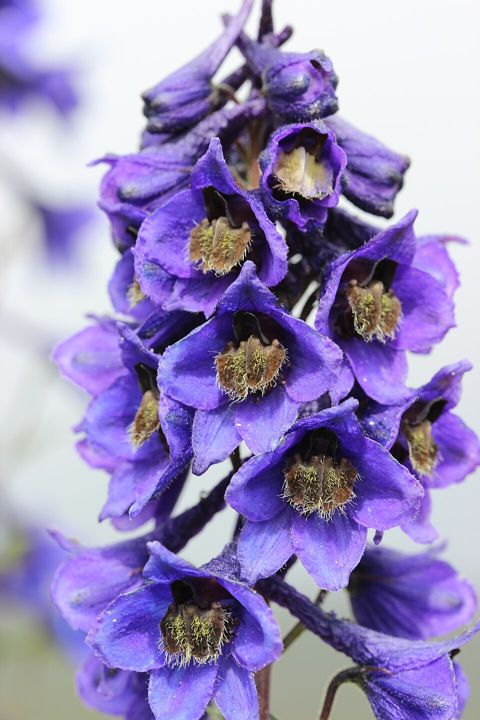
An erect perennial up to 1.8 m with deeply divided palmate leaves. Tall dense racemes of blue or purple flowers in summer (white, pink and bicolours in cultivars), each with a spur behind like a lark's claw or a swallow's tail, the source of the Chinese names; a dark or white eye of petals at the centre, the bee of the English name bee larkspur. The main parent of the tall garden delphiniums of the Elatum group. The whole plant is poisonous.
Habitat
Mountain meadows, forest edge and streamsides in cool moist rich soil; a tall back-of-border perennial that needs staking.
Distribution
Native to Europe and temperate Asia (from the Alps and Pyrenees through central Europe to Siberia, Mongolia and Xinjiang); wild in Xinjiang, grown in borders in northern and highland China, grown in cool parts of Japan and Hokkaido (derufiniumu), absent from Singapore.
Season and behaviour
June and July, July and August on high ground; a spike opens from the bottom over two or three weeks and cutting it back brings an autumn flush.
Photography tips
These are the FilmAnalysis editors' notes, not content from the sources.
A blue spike one or two metres tall is the highest vertical in a border: a portrait frame from low so it stands against the sky; blue-violet is truest under cloud. Macro for the spur and the bee at the centre of one flower. Rows compress into blue columns with a long lens. Spikes sway in wind, so 1/500 s or faster. Poisonous: keep children from touching it.
Photographic styles
Blue columns against the sky; macro of the bee at the flower's heart.
Similar species
Rocket larkspur, Consolida ajacis (annual, sparse flowers, finely cut leaves); Delphinium grandiflorum (short, large sparse flowers, wild in northern China); monkshood (hooded flowers, no spur).
Related badge
None yet. No validated photo recognition exists for this species, so no badge is tied to it: a name in the encyclopedia is not evidence in a photograph.
The illustration is original FilmAnalysis artwork. The photograph is from Wikimedia Commons; its licence and author are under it.
Why it is listed: this species comes from the Flower checklist (GBIF backbone and Wikidata verified). Names follow the GBIF backbone and Wikidata; the facts follow the sources below; photo recognition is not offered.