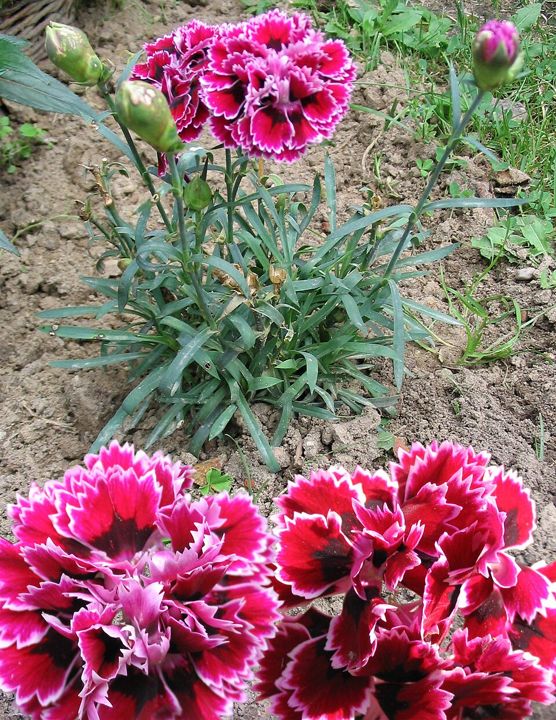
A perennial up to 80 cm. Glaucous greyish to blue-green slender leaves up to 15 cm. Flowers singly or up to five in a cyme, 3–5 cm across, sweetly scented, often described as clove-like, cinnamon or nutmeg; petals toothed or fringed, the wild colour bright pinkish-purple and cultivars red, pink, yellow, white and green (never a true blue; blue carnations are dyed). Four to six egg-shaped pointed scales surround the calyx at a quarter of the tube's length. Mentioned in Greek texts over two thousand years ago; the pink carnation has stood for Mother's Day since 1907.
Habitat
Glasshouse cut-flower fields, beds and pots; wild plants on Mediterranean rocks and walls.
Distribution
Native to the Mediterranean (Portugal, Spain, Italy, Croatia, Greece and elsewhere), the exact origin obscured by two millennia of cultivation; Yunnan is Asia's largest cut-carnation producer, and it is grown in beds and pots across China and Japan (kāneshon) and imported and potted in Singapore.
Season and behaviour
Glasshouse cut flowers all year, outdoors May to July; its season is Mother's Day, the second Sunday in May.
Photography tips
These are the FilmAnalysis editors' notes, not content from the sources.
The fringed petal edge is its mark: a head-on macro for the layered frills, in soft light; half a stop under for red and for white and pink alike. Cut stems in window light as still life, the grey-green stems a ready cool contrast. Mother's Day bouquets are a people subject. Rows of colour in a field compress with a long lens.
Photographic styles
Macro of frilled petals; cut flowers in window light.
Similar species
China pink, Dianthus chinensis (small single bedding flowers); sweet william, Dianthus barbatus (small flowers in dense heads); fringed pink (petals cut into threads).
Related badge
None yet. No validated photo recognition exists for this species, so no badge is tied to it: a name in the encyclopedia is not evidence in a photograph.
The illustration is original FilmAnalysis artwork. The photograph is from Wikimedia Commons; its licence and author are under it.
Why it is listed: this species comes from the Flower checklist (GBIF backbone and Wikidata verified). Names follow the GBIF backbone and Wikidata; the facts follow the sources below; photo recognition is not offered.