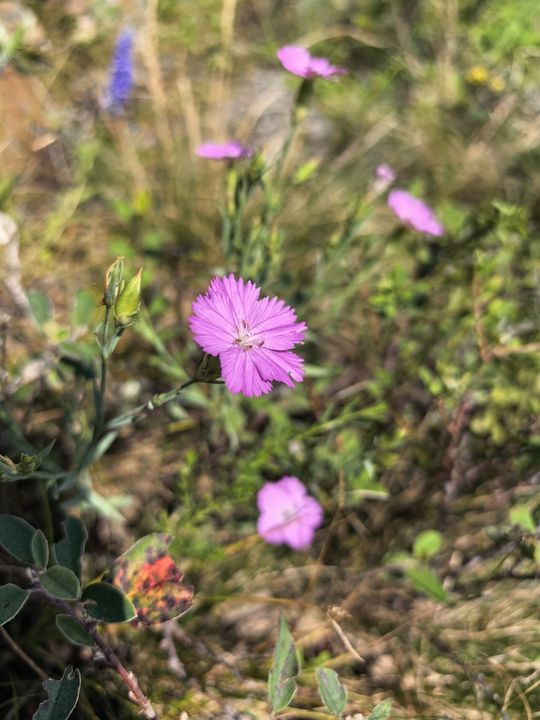
Photo: Svetlana Polevova, via iNaturalist, public domain / CC0. Unmodified apart from resizing.
Colour
pink, red, white
Region
Japan and temperate East Asia
Season
spring, summer
Shape
single flower
Identification
A herbaceous perennial 30–50 cm tall with branched stems forming a loose clump, the nodes swollen like bamboo, hence the Chinese name stone bamboo. Green to greyish-green slender leaves 3–5 cm long and 2–4 mm wide; the basal leaves usually withered by flowering. Flowers white, pink or red, 3–4 cm across, single, in pairs or small clusters, up to 15 in a cyme in garden forms; the petal edges serrated and the centre often ringed darker, hence rainbow pink. Four bracts reach halfway up the calyx; the calyx a cylinder 1.5–2.5 cm long. Black seeds. The carnation is a relative.
Habitat
Steppe, hill grassland, forest edge and river flats, hardy and drought-tolerant; widely grown in beds and one of the commonest perennials of northern gardens.
Distribution
Native to northern China, Korea, Mongolia and south-eastern Russia; common from north-east and northern China to the Yangtze basin and grown everywhere; grown in Japan (sekichiku or kara-nadeshiko, as against the native kawara-nadeshiko), absent from Singapore.
Season and behaviour
Peak bloom May to July, spring to summer in garden forms; each flower lasts days and a plant flowers for over a month.
Photography tips
These are the FilmAnalysis editors' notes, not content from the sources.
The serrated petal edges and dark central ring are the macro point, most graphic straight down; pink stays pink in soft light. In a loose clump use a wide aperture to choose one flower and blur the rest into dots. The swollen stem nodes are the identification detail.
Photographic styles
Head-on graphics of serrated petals; pink dots on grass.
Similar species
Fringed pink (petals deeply cut into fringes); carnation (large double, glasshouse); sweet william (small flowers packed in heads).
Related badge
None yet. No validated photo recognition exists for this species, so no badge is tied to it: a name in the encyclopedia is not evidence in a photograph.
The illustration is original FilmAnalysis artwork. The photograph is from iNaturalist; its licence and author are under it.
Why it is listed: this species comes from the Flower checklist (GBIF backbone and Wikidata verified). Names follow the GBIF backbone and Wikidata; the facts follow the sources below; photo recognition is not offered.