Elsewhere (in East Asia only in bird parks or botanic gardens)
Season
spring, summer
Shape
cluster
IUCN status
Vulnerable
Identification
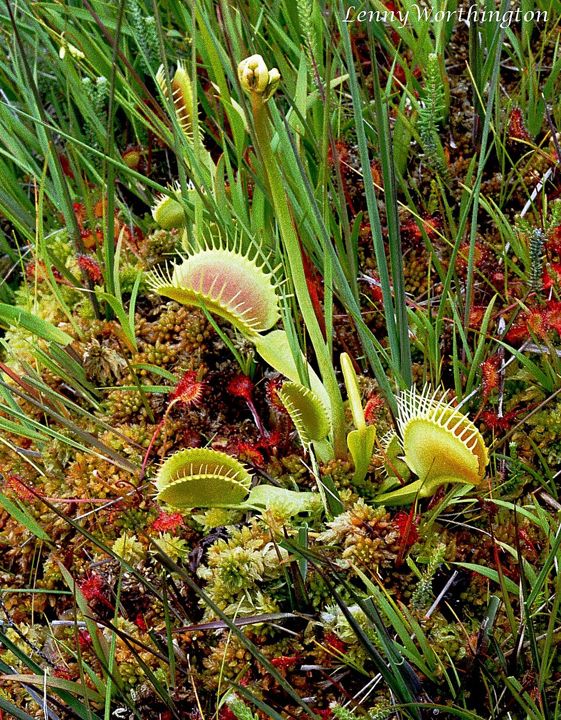
A small carnivorous plant, a rosette of four to seven leaves from a short bulb-like underground stem, each stem 3–10 cm at most, longer leaves with robust traps after flowering. Each leaf ends in a two-lobed hinged trap with regular marginal bristles (the lashes of Venus), often red within; when an insect touches the trigger hairs in succession the trap snaps shut in a fraction of a second, among the fastest movements in the plant kingdom, hence the Chinese and Japanese nickname hell for flies. Small white five-petalled flowers on a tall scape held well above the traps so pollinators are not eaten. The only species of its genus, related to the waterwheel plant and the sundews. Assessed Vulnerable by the IUCN.
Habitat
Nitrogen- and phosphorus-poor bogs, wet savannahs and wet sand at home, depending on periodic fire to suppress competitors; a pot plant worldwide in sphagnum and pure water.
Distribution
Native only to a stretch of coastal plain in North and South Carolina in the United States; entirely cultivated in East Asia, common in Chinese flower markets and among carnivorous-plant growers, in Japanese garden centres (haetorisō), in Singapore's flower markets too. Wild collection is illegal.
Season and behaviour
Flowers in May and June; traps largest and reddest from spring to autumn, dormant and small in winter.
Photography tips
These are the FilmAnalysis editors' notes, not content from the sources.
The trap is the subject: a head-on macro of an open trap, its bristles and red interior, with backlight making the bristles glow; film the closing on video rather than triggering it repeatedly for stills (a trap dies after a few closures). The small white flowers stand above the traps, so frame the whole plant. All cultivated plants; do not go looking in the wild.
Photographic styles
Macro of an open red trap; bristles glowing against the light.
None yet. No validated photo recognition exists for this species, so no badge is tied to it: a name in the encyclopedia is not evidence in a photograph.
The illustration is original FilmAnalysis artwork. The photograph is from Wikimedia Commons; its licence and author are under it.
Why it is listed: this species comes from the Flower checklist (GBIF backbone and Wikidata verified). Names follow the GBIF backbone and Wikidata; the facts follow the sources below; photo recognition is not offered.