Elsewhere (in East Asia only in bird parks or botanic gardens)
Season
spring, summer
Shape
large head
IUCN status
Least Concern
Identification
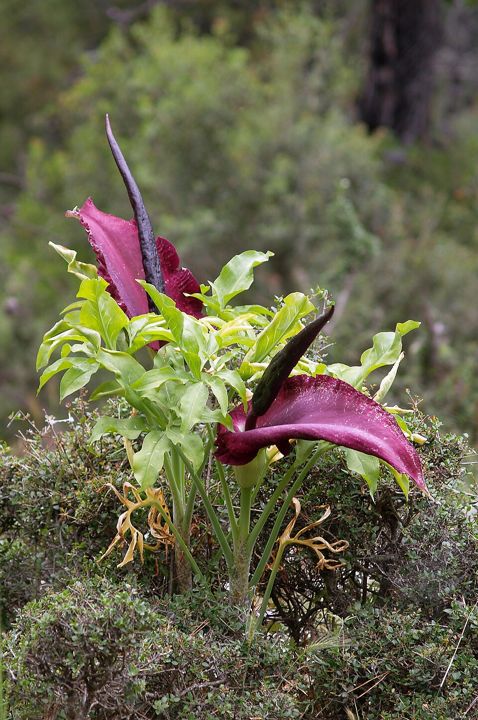
An arum perennial endemic to the Balkans and the Aegean. Large deeply palmate leaves with occasional cream flecks along the veins and snakeskin-mottled stalks. The inflorescence is a huge purple-red to purple-black spathe up to a metre long with a long spadix of the same colour standing in it like a small dragon peering out (the Greek name means little dragon), hence dragon arum, dragon lily and vampire lily. It gives off a stench of rotting meat to draw blowflies as pollinators and heats itself to about 18 °C; a floral chamber at the base of the spathe holds the insects until the pollen is shed. The whole plant is poisonous.
Habitat
Scrub, olive groves, roadsides and the foot of stone walls at home, dormant through the dry summer; a curiosity in temperate gardens and botanic gardens.
Distribution
Endemic to the Balkans as far as Greece, Crete and the Aegean islands, and to south-western Anatolia, naturalised in parts of Europe and America; only in botanic gardens and a few collections in East Asia, with no wild plants in China, Japan or Singapore.
Season and behaviour
April to June, late spring; a spathe lasts two or three days, the smell strongest on the first.
Photography tips
These are the FilmAnalysis editors' notes, not content from the sources.
A purple-black spathe swallows light, so add a stop; side or back light brings out the velvet texture and frilled edge, and a pale background works better than a dark one. A portrait frame at eye level for the metre-long spadix rising from the spathe; macro for the snakeskin stalks. The smell is worst on day one, so shoot and leave. Poisonous: avoid the sap.
Photographic styles
A purple-black spadix standing up; macro of snakeskin stalks.
Similar species
Titan arum (far larger, Sumatra); lords-and-ladies, Arum maculatum (small, pale green spathe); konjac (a similarly tall spadix and purple-brown spathe, seen in East Asia).
Related badge
None yet. No validated photo recognition exists for this species, so no badge is tied to it: a name in the encyclopedia is not evidence in a photograph.
The illustration is original FilmAnalysis artwork. The photograph is from Wikimedia Commons; its licence and author are under it.
Why it is listed: this species comes from the Flower checklist (GBIF backbone and Wikidata verified). Names follow the GBIF backbone and Wikidata; the facts follow the sources below; photo recognition is not offered.