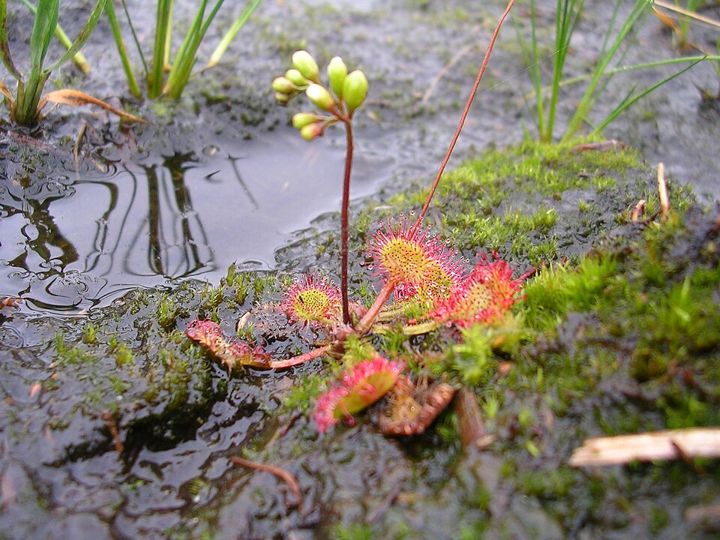
A carnivorous plant whose leaves form a basal rosette: narrow hairy petioles 1.3–5 cm long carry round laminae 4–10 mm across, their upper surface densely covered with red glandular hairs secreting droplets of sticky mucilage that glitter like dew in sun and fold round trapped insects. A typical plant is 3–5 cm across with a 5–25 cm slender hairless scape from the centre of the rosette, the white or pink five-petalled flowers on one side of it; slender seeds 1–1.5 mm. It overwinters as a hibernaculum of tightly curled leaves at ground level.
Habitat
Bogs, marshes, fens and wet acid slopes, commonest on sphagnum cushions; one of the most widespread sundews.
Distribution
Circumboreal: almost all of Europe, all of Siberia, large parts of North America, Korea and Japan, south to eastern China and the Philippines and even New Guinea. In the bogs of north-east and eastern China's hills, and common in Japan's mires from Hokkaido to Kyushu (Oze, Kushiro). Absent from Singapore.
Season and behaviour
Flowers June to August, briefly on sunny mornings; the dew on the leaves can be photographed all season, brightest in early backlight.
Photography tips
These are the FilmAnalysis editors' notes, not content from the sources.
A macro subject: the mucilage drops on the red hairs are diamonds against the light, with a macro lens and small aperture, lying on the boardwalk (never step into the bog). The whole plant is a few centimetres, so focus-stack. A leaf closed on an insect is the documentary detail. The small white flower head-on in macro.
Photographic styles
Glandular dew glittering against the light; red microscapes on sphagnum.
None yet. No validated photo recognition exists for this species, so no badge is tied to it: a name in the encyclopedia is not evidence in a photograph.
The illustration is original FilmAnalysis artwork. The photograph is from Wikimedia Commons; its licence and author are under it.
Why it is listed: this species comes from the Flower checklist (GBIF backbone and Wikidata verified). Names follow the GBIF backbone and Wikidata; the facts follow the sources below; photo recognition is not offered.