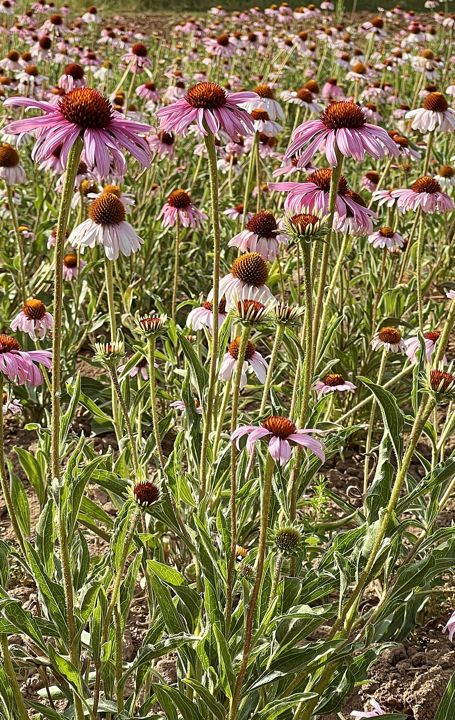
A perennial up to 120 cm tall and 25 cm wide at maturity. Alternate leaves on stalks of 0–17 cm, oval to lanceolate, 5–30 by 5–12 cm, entire to toothed. Heads 7–15 cm across with a prominent domed cone of many small orange-brown spiny florets (the genus name means hedgehog) ringed by pink or purple rays that droop back; usually purple in the wild. Hermaphrodite florets pollinated by butterflies and bees. Flowering through summer into autumn. The cones stand through winter and feed goldfinches. A famous herbal plant.
Habitat
Dry open woods, prairies and barrens; widely grown as a border and meadow-garden perennial, drought-tolerant and hardy.
Distribution
Native to eastern North America, commonest in the Ozarks and the Mississippi and Ohio valleys and reaching Ontario; common in borders in northern and eastern China, in Japanese beds (murasaki-barengiku, ekinasea), absent from Singapore.
Season and behaviour
June to September, peaking July and August; a flower lasts a month, the cone rising as it ages.
Photography tips
These are the FilmAnalysis editors' notes, not content from the sources.
The domed cone is its trademark: side-on at eye level for the drooping rays and the rising cone, with backlight making the orange spines glow; from above for the spiral of concentric circles. Pink-purple is truest in soft light. Butterflies settle on the cone, 1/1000 s. The dried cones with frost or snow are another season's subject.
Photographic styles
A cone glowing against the light; drooping rays in profile.
Similar species
Narrow-leaved coneflower, Echinacea angustifolia (narrow leaves, thinner rays); black-eyed Susan (yellow rays, black disc); dahlias (no raised cone).
Related badge
None yet. No validated photo recognition exists for this species, so no badge is tied to it: a name in the encyclopedia is not evidence in a photograph.
The illustration is original FilmAnalysis artwork. The photograph is from Wikimedia Commons; its licence and author are under it.
Why it is listed: this species comes from the Flower checklist (GBIF backbone and Wikidata verified). Names follow the GBIF backbone and Wikidata; the facts follow the sources below; photo recognition is not offered.