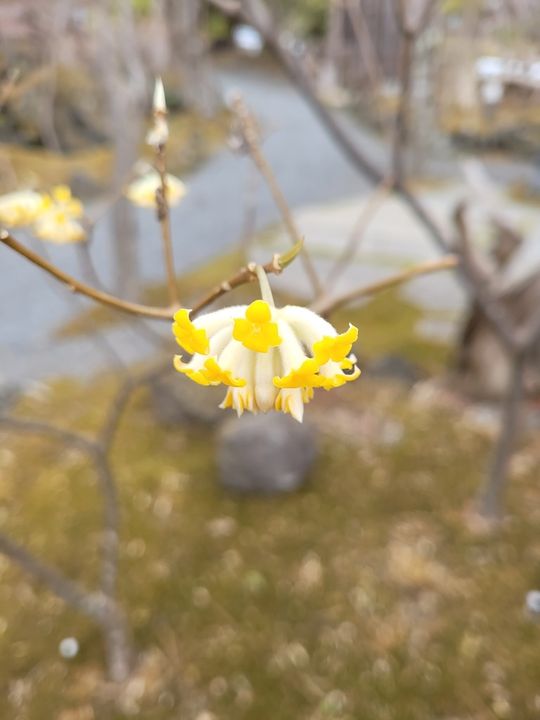
Photo: Subir B. Shakya, via iNaturalist, licensed CC BY 4.0. Unmodified apart from resizing.
Colour
yellow
Region
Japan and temperate East Asia
Season
spring, winter
Shape
cluster
Identification
A deciduous shrub 1.2–1.8 m tall whose branches fork in threes (hence the Japanese name mitsumata) and are supple enough to tie in knots. Alternate lanceolate leaves 7.6–12.7 cm, dark green, hairy on both sides. In early spring, before the leaves, drooping hemispherical heads of flowers without petals, the apparent four lobes being the calyx tube, golden yellow and covered outside in white down, sweetly scented; flowering February to April. The bark fibre makes the paper of Japanese banknotes.
Habitat
Mountain forest and shrubby slopes, widely planted in gardens and temple grounds; likes half shade and moisture.
Distribution
Native to Myanmar and south-central and south-eastern China; naturalised and grown on a large scale in Japan for paper; common in gardens south of the Yangtze. Absent from Singapore.
Season and behaviour
February to April, opening before the leaves, one of the first scented flowers of early spring; the buds are formed in winter, silvery downy balls hanging on the twigs.
Photography tips
These are the FilmAnalysis editors' notes, not content from the sources.
The drooping hemispheres want an upward view, golden flowers against sky or dark twigs; the silver-white winter buds have a velvety look in side light and make the other picture. Small dense flowers suit a macro of their arrangement in dozens. The three-forked branching is a subject in itself, clearest after leaf fall.
Photographic styles
Golden pompons hanging in early spring; the geometry of three-forked twigs.
None yet. No validated photo recognition exists for this species, so no badge is tied to it: a name in the encyclopedia is not evidence in a photograph.
The illustration is original FilmAnalysis artwork. The photograph is from iNaturalist; its licence and author are under it.
Why it is listed: this species comes from the Flower checklist (GBIF backbone and Wikidata verified). Names follow the GBIF backbone and Wikidata; the facts follow the sources below; photo recognition is not offered.