Singapore and tropical Asia, Japan and temperate East Asia
Season
summer, autumn
Shape
large head
IUCN status
Least Concern
Identification
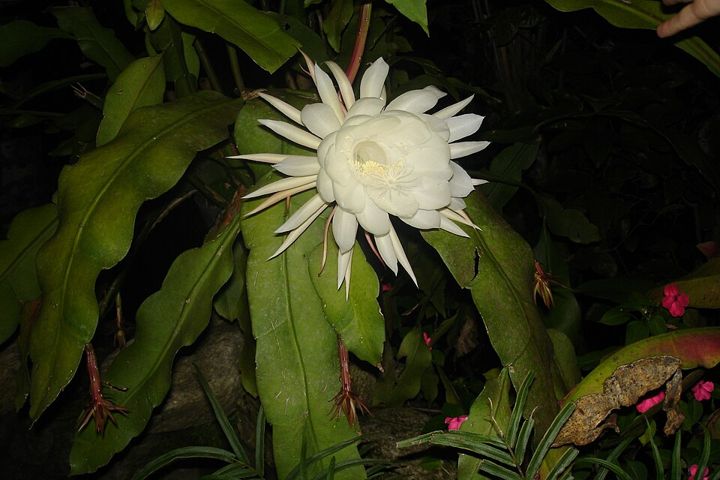
An epiphytic cactus with erect, ascending or sprawling much-branched stems; the primary stems terete, up to 6 m and woody at the base, the secondary stems flat, elliptic-acuminate, up to 30 by 12 cm with shallowly to deeply crenate wavy margins, leaf-like and often mistaken for leaves. Huge white flowers up to 17 cm across open at night and wilt before dawn, heavily scented; the Chinese idiom for a fleeting moment is the flowering of this plant, and the Japanese name means beauty under the moon. Stems full of water-storing tissue that oozes gel when cut. Though called a night-blooming cereus, it is not closely related to the true cereus tribe.
Habitat
On trees in tropical forest in its homeland; a pot plant worldwide, widely escaped in South-East Asia and naturalised in China.
Distribution
Native from southern Mexico to Nicaragua and widely in South America; a balcony and courtyard pot plant across China and naturalised in the south, a pot plant in Japan (gekka-bijin), common on Singapore's garden walls and housing-estate balconies.
Season and behaviour
June to October, July to September in southern China, nearly all year in Singapore; each flower lasts one night, opening from eight or nine, full by eleven or twelve, closed before dawn.
Photography tips
These are the FilmAnalysis editors' notes, not content from the sources.
Night flowering is the whole difficulty: a bud lifting its head with loosening bracts at dusk opens that night, so set up a tripod and one continuous light (no frontal flash). Full open is between eleven and one; a time-lapse from bud to full flower. The huge white flower before darkness wants half a stop to a stop under. The wilted flower at dawn is the other half of the fleeting moment.
Photographic styles
A huge white flower fully open at night; a time-lapse from bud to bloom.
None yet. No validated photo recognition exists for this species, so no badge is tied to it: a name in the encyclopedia is not evidence in a photograph.
The illustration is original FilmAnalysis artwork. The photograph is from Wikimedia Commons; its licence and author are under it.
Why it is listed: this species comes from the Flower checklist (GBIF backbone and Wikidata verified). Names follow the GBIF backbone and Wikidata; the facts follow the sources below; photo recognition is not offered.