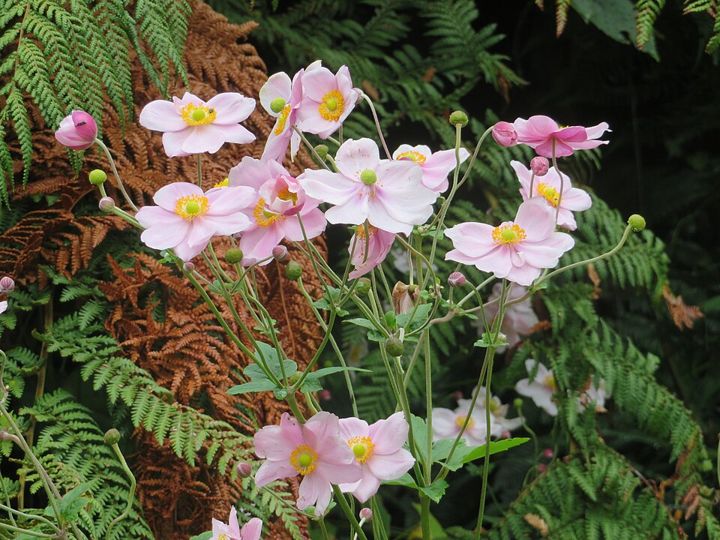
A rhizomatous clump-forming perennial with three to five basal leaves on petioles 5–35 cm, ternate with a central leaflet 4–10 cm. Stems 30–100 cm, occasionally 120 cm, with a whorl of three leafy bracts. A cyme of two or three branches; flowers about 5 cm across, in the wild usually with five pink sepals (no petals), double in cultivation, the double form called autumn peony in Chinese; a ring of yellow stamens at the centre. The fruits are woolly white like cotton, hence the Chinese name wild cotton flower. The epithet means from Hubei. Still often called Anemone hupehensis.
Habitat
Hill grassland, forest edge, ditch sides and roadsides in moist half shade; widely grown in autumn borders.
Distribution
Native across a large area of Asia, common in the hills of south-west, central, eastern and northern China; introduced to Japan from China and naturalised (shūmeigiku), the signature flower of the autumn garden; absent from Singapore.
Season and behaviour
August to October, peaking in September and October; in Japanese temple gardens it runs on into the red leaves.
Photography tips
These are the FilmAnalysis editors' notes, not content from the sources.
The slender stems sway, so 1/640 s or faster; the pink sepals are translucent against the light and the ring of yellow stamens is the focus in a head-on macro. A wide aperture for a single flower turns the round buds behind into dots. The cottony seed heads against the light are the other picture. Shūmeigiku with a moss garden in a Kyoto temple wants a medium lens.
Photographic styles
Pink flowers translucent against the light; an autumn temple border.
Similar species
Anemone tomentosa (white or pale pink sepals, larger leaves, northern); spring anemones (low, spring-flowering); the autumn peony is its double form.
Related badge
None yet. No validated photo recognition exists for this species, so no badge is tied to it: a name in the encyclopedia is not evidence in a photograph.
The illustration is original FilmAnalysis artwork. The photograph is from Wikimedia Commons; its licence and author are under it.
Why it is listed: this species comes from the Flower checklist (GBIF backbone and Wikidata verified). Names follow the GBIF backbone and Wikidata; the facts follow the sources below; photo recognition is not offered.