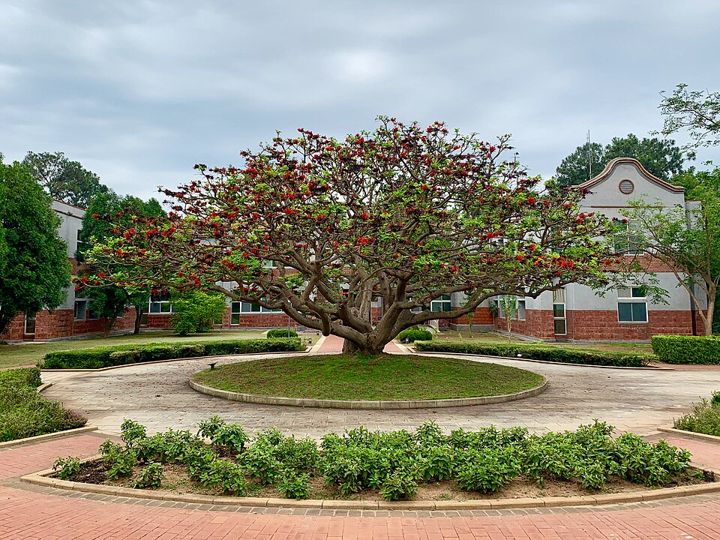
A thorny deciduous tree to 27 m. Trifoliate leaves on 20 cm petioles with broad leaflets up to 20 cm long and wide. Dense clusters of scarlet or crimson pea flowers, the large standard turned up like rows of parrot beaks, opening before the leaves so the whole tree is red; black seeds. Crows and other birds feed on the nectar and help pollinate it. The city flower of Quanzhou (nicknamed the coral-tree city) and of Miyakojima in Japan; the Kavalan people of Taiwan mark the new year by its flowering.
Habitat
Coral-reef coasts, seaside forest edge, villages and streets, tolerant of salt and wind; a street tree and living fence post in southern China and South-East Asia.
Distribution
Native to the coral coasts of tropical Asia and the Pacific islands, eastern Africa, the Indian subcontinent, northern Australia and the Indian Ocean islands east to Fiji; common on the coasts and streets of Singapore and southern China (Fujian, Guangdong, Hainan, Taiwan), and the emblem tree of Okinawa and Miyakojima.
Season and behaviour
March and April in southern China and Taiwan, before the leaves; January to March in Singapore's dry season; March to May in Okinawa (deigo). About a month.
Photography tips
These are the FilmAnalysis editors' notes, not content from the sources.
Clusters of red on bare branches are cleanest from below against blue sky, the red saturated in front light and a silhouette against it, half a stop under. Birds come for nectar without fail (sunbirds, mynas, crows): wait at one tree with a long lens at 1/1600 s. Fallen flowers on the ground look like little parrot beaks from above.
Photographic styles
Red clusters on bare branches under blue sky; birds at the nectar.
Similar species
Cockspur coral tree (shrubby, deep red, long season, South America); Erythrina corallodendron (slender flowers like dragon teeth, Mexico); ivory coral is a garden name for this species.
Related badge
None yet. No validated photo recognition exists for this species, so no badge is tied to it: a name in the encyclopedia is not evidence in a photograph.
The illustration is original FilmAnalysis artwork. The photograph is from Wikimedia Commons; its licence and author are under it.
Why it is listed: this species comes from the Flower checklist (GBIF backbone and Wikidata verified). Names follow the GBIF backbone and Wikidata; the facts follow the sources below; photo recognition is not offered.