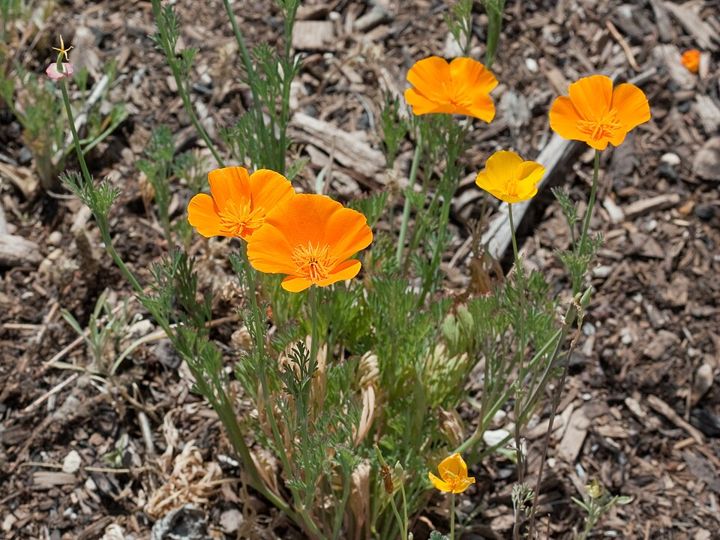
Photo: Kaldari, via Wikimedia Commons, public domain / CC0. Unmodified apart from resizing.
Colour
orange, yellow
Region
Japan and temperate East Asia
Season
spring, summer
Shape
single flower
Identification
A perennial or annual 13–30 cm tall with alternately branching glaucous blue-green foliage finely divided into rounded lobes. Solitary silky flowers on long stems, four petals each 2–6 cm, mostly orange, also yellow and red, occasionally pink and white; the petals close at night and in cold windy weather, reopen the next morning, and may stay closed on cloudy days. A slender capsule 3–9 cm long that splits in two at ripeness, sometimes with an audible snap that flings the seeds. The state flower of California, which keeps 6 April as California Poppy Day.
Habitat
Grassland, open ground and roadsides from sea level to 2,000 m, drought-tolerant and sun-loving; grown in beds and wildflower meadows and naturalised in places.
Distribution
Native to the western United States (California and Oregon, Washington, Nevada, Arizona, New Mexico) and north-western Mexico; grown in spring beds across China, common in Japanese beds and wildflower strips (hanabishisō), scarce in Singapore.
Season and behaviour
February to September in the northern hemisphere, peaking in beds from April to June; the flowers open only by day in sun.
Photography tips
These are the FilmAnalysis editors' notes, not content from the sources.
The silky orange petals open only in sun, so it is a fine-weather subject, half a stop under to hold the orange; against the light the petals glow like a lamp, its best picture. The blue-green divided leaves are a soft background. Massed beds from above become an orange carpet. The closed evening buds like little pointed caps are worth a frame too.
Photographic styles
Orange cups glowing against the light; orange on blue-green leaves.
Similar species
Corn poppy, Papaver rhoeas (red, thinner petals); Iceland poppy (leafless stalks, many colours); pot marigold (a composite head, not a four-petalled flower).
Related badge
None yet. No validated photo recognition exists for this species, so no badge is tied to it: a name in the encyclopedia is not evidence in a photograph.
The illustration is original FilmAnalysis artwork. The photograph is from Wikimedia Commons; its licence and author are under it.
Why it is listed: this species comes from the Flower checklist (GBIF backbone and Wikidata verified). Names follow the GBIF backbone and Wikidata; the facts follow the sources below; photo recognition is not offered.