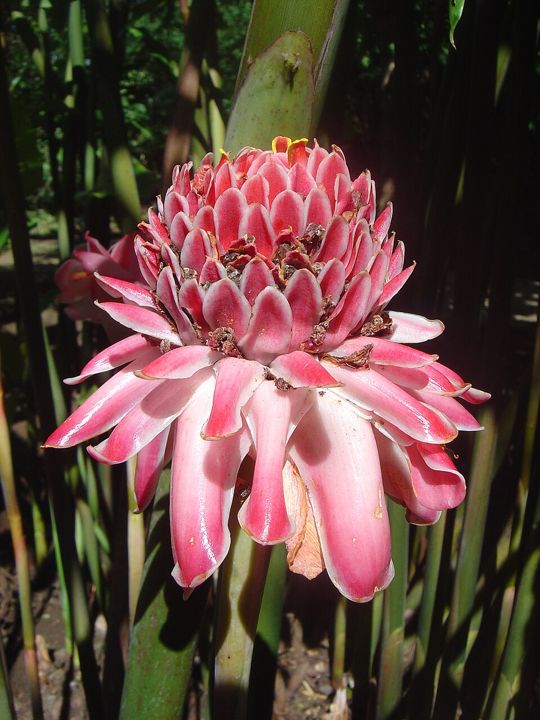
A large perennial whose pseudostems rise from a rhizome, with leathery leaves about 85 cm long and 18 cm wide with a central groove, the clump 3–6 m tall. The inflorescence comes up separately from the ground on a scape over a metre tall, topped by a torch-like head: waxy pink (also red and white) bracts layered like a lotus or torch, the true flowers small, red with white edges, emerging between the bracts in turn. The bracts flavour South-East Asian dishes (laksa, otak-otak), hence the names torch ginger and porcelain rose.
Habitat
Rainforest edge and damp streamsides, widely planted in tropical parks, resorts and gardens, one of the showiest tropical flowering plants.
Distribution
Native to the Malay Peninsula, the Indonesian islands and New Guinea; very common in Singapore's parks and botanic gardens, grown in southern China (Guangdong, Yunnan, Hainan), and in Japan only under glass and in Okinawa.
Season and behaviour
Flowers all year in the tropics, most after the rains; one head lasts a month, first tight as a torch, then opening like a lotus.
Photography tips
These are the FilmAnalysis editors' notes, not content from the sources.
Waxy pink bracts look like porcelain in soft light and flare white in sun, half a stop under; side light for the layered relief, straight down for the opened lotus. The small true flowers want macro. The scape grows apart from the huge leaves, so a long lens from low down shows it standing before dark green.
Photographic styles
Porcelain-pink torches; the opened lotus from above.
None yet. No validated photo recognition exists for this species, so no badge is tied to it: a name in the encyclopedia is not evidence in a photograph.
The illustration is original FilmAnalysis artwork. The photograph is from Wikimedia Commons; its licence and author are under it.
Why it is listed: this species comes from the Flower checklist (GBIF backbone and Wikidata verified). Names follow the GBIF backbone and Wikidata; the facts follow the sources below; photo recognition is not offered.