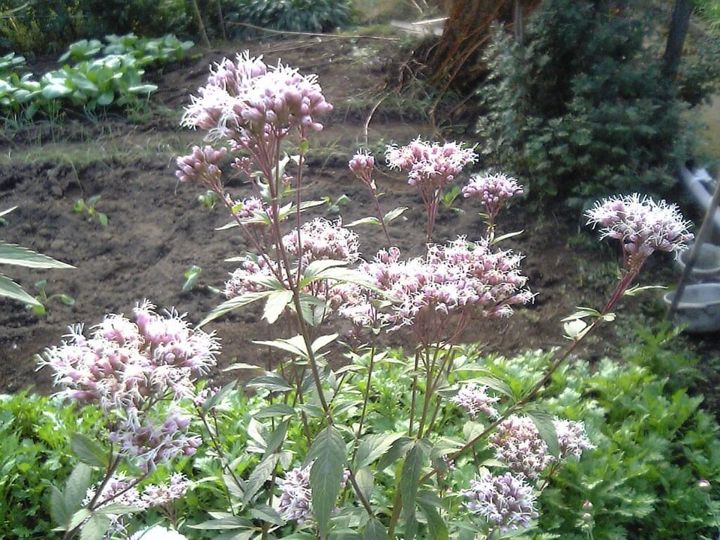
A perennial 50–200 cm tall from short rhizomes with many fibrous roots. Upright stems marked purplish red, branching near the top into flat corymbose heads. Opposite leaves on short thick petioles, the middle ones elliptic, ovate-elliptic or lanceolate, 6–20 cm long, pinnately veined and sometimes three-parted; the basal leaves wither before flowering. Small heads of disc florets only, white or pinkish, the styles projecting like white hair, hence the Chinese name white-headed old woman. Fujibakama, the Japanese relative, is one of the seven autumn herbs.
Habitat
Hill grassland, forest edge, streamsides and damp roadsides in sun; much visited by butterflies, especially milkweed butterflies, and the migrating chestnut tiger often rests on it in autumn.
Distribution
Native to China, Japan and Korea; common in the hills from north-east to southern China and throughout Japan. Absent from Singapore.
Season and behaviour
August to November, peaking in September and October; with wild chrysanthemum and golden lace it is the base colour of autumn fields.
Photography tips
These are the FilmAnalysis editors' notes, not content from the sources.
The fine white flowers want the whole flat head, the projecting styles like white fuzz against the light and a dark background; when a butterfly lands it becomes a butterfly picture at 1/1600 s. The purple-red spots on the stem are the identification mark, worth one close-up. Low autumn evening light suits it best.
Photographic styles
White flat heads in autumn fields; butterflies with flowers.
Similar species
Eupatorium fortunei (leaves cut in three, medicinal, strongly scented); Eupatorium lindleyanum (narrower, more divided leaves); fujibakama (the Japanese relative, pale purple).
Related badge
None yet. No validated photo recognition exists for this species, so no badge is tied to it: a name in the encyclopedia is not evidence in a photograph.
The illustration is original FilmAnalysis artwork. The photograph is from Wikimedia Commons; its licence and author are under it.
Why it is listed: this species comes from the Flower checklist (GBIF backbone and Wikidata verified). Names follow the GBIF backbone and Wikidata; the facts follow the sources below; photo recognition is not offered.