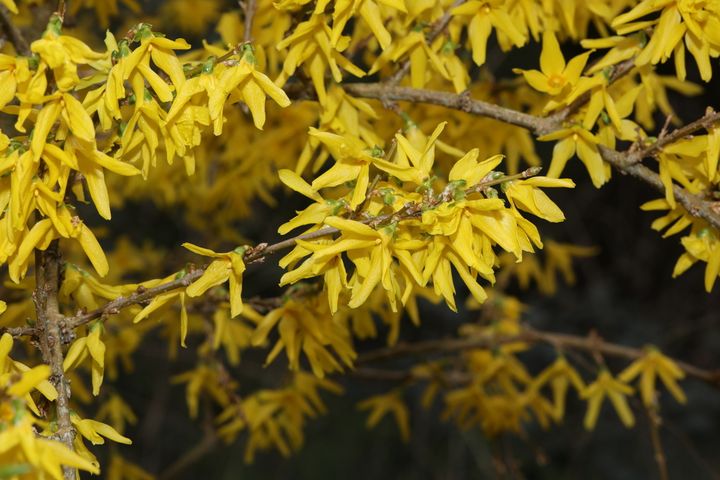
Photo: Stephen James McWilliam, via iNaturalist, public domain / CC0. Unmodified apart from resizing.
Colour
yellow
Region
Japan and temperate East Asia
Season
spring
Shape
single flower
Identification
A deciduous shrub to 3 m with arching, even trailing branches that can be grown as a weeping shrub on stream banks; hollow stems. Opposite leaves, simple or in threes, broadly ovate and toothed. Golden-yellow four-lobed bell flowers open before the leaves, packed along last year's shoots, hence the Hong Kong name string of gold. Flowers in March and April, slightly paler than the garden hybrids. The fruit is the medicinal lianqiao. Once thought a parent of the hybrid Forsythia × intermedia.
Habitat
Hillside thickets, valleys and grassy slopes in open woodland, widely planted in gardens, parks and roadside hedges; prized for its toughness in cold and poor soil.
Distribution
Native to China, common in the hills from the north and north-west to the centre and grown everywhere; introduced to Japan (rengyō), Korea, Europe and parts of the United States. Absent from Singapore.
Season and behaviour
March and April, among the first yellow flowers of the northern early spring, around the time of winter jasmine and magnolia; two or three weeks.
Photography tips
These are the FilmAnalysis editors' notes, not content from the sources.
Arching branches covered in yellow are a subject of lines: follow the curve with a long lens against still-bare dark woodland or blue sky; gold is truest under cloud and bleaches in sun, half a stop under. Small dense flowers want a macro of the four-lobed bell and orange centre. Early-spring dead grass is the same colour, so find a dark backdrop.
Photographic styles
Strings of gold on early-spring arches; lines against a dark background.
None yet. No validated photo recognition exists for this species, so no badge is tied to it: a name in the encyclopedia is not evidence in a photograph.
The illustration is original FilmAnalysis artwork. The photograph is from iNaturalist; its licence and author are under it.
Why it is listed: this species comes from the Flower checklist (GBIF backbone and Wikidata verified). Names follow the GBIF backbone and Wikidata; the facts follow the sources below; photo recognition is not offered.