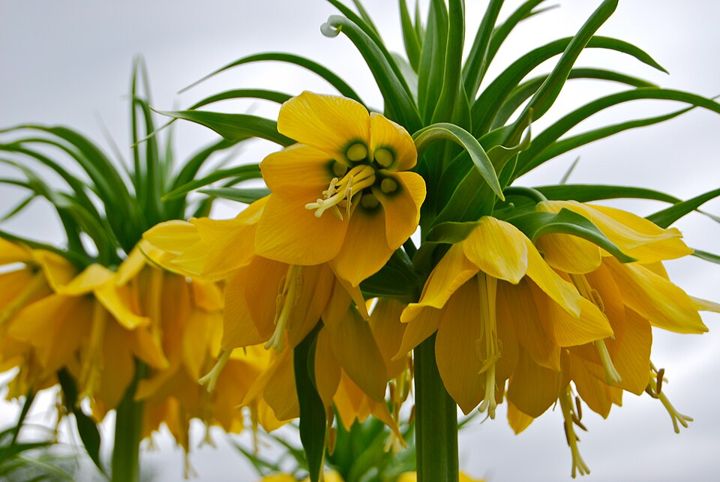
A bulb about 1 m tall with glossy lance-shaped leaves at intervals along the stem. A prominent whorl of downward-facing bell flowers at the top, crowned by a tuft of small leaves, hence crown imperial; orange-red in the wild, cultivars from nearly true scarlet through orange to yellow. Inside each flower a ring of large nectar drops hangs like pearls. Flowers in late spring with a distinctly foxy smell that repels mice and moles. The epithet means of the emperor.
Habitat
Mountain grassland and rocky slopes at 1,000–3,000 m at home; an autumn-planted border bulb wanting drainage and a dry summer.
Distribution
Native across Asia from Turkey, Iran (Kurdistan), Iraq, Afghanistan and Pakistan to northern India and the Himalayan foothills, naturalised in Austria, Sicily and Washington State; grown in borders and flower shows in northern and eastern China, a little in Japanese beds (yōraku-yuri), absent from Singapore.
Season and behaviour
April and May, late spring, with the tulips; a whorl lasts two weeks.
Photography tips
These are the FilmAnalysis editors' notes, not content from the sources.
A whorl of nodding bells under a tuft of leaves: side-on at flower level for the outline of the crown, from low so it stands against the sky; half a stop under for orange-red. Shoot up into one bell to see the ring of shining nectar drops at its base, its most singular macro. The smell is strong, so shoot and go.
Photographic styles
A whorl of bells under a green crown; macro of nectar drops inside a flower.
Similar species
Persian lily, Fritillaria persica (deep purple, a raceme); fritillaries such as Fritillaria thunbergii (small yellow-green chequered flowers); lilies (flowers facing up or out, no crown).
Related badge
None yet. No validated photo recognition exists for this species, so no badge is tied to it: a name in the encyclopedia is not evidence in a photograph.
The illustration is original FilmAnalysis artwork. The photograph is from Wikimedia Commons; its licence and author are under it.
Why it is listed: this species comes from the Flower checklist (GBIF backbone and Wikidata verified). Names follow the GBIF backbone and Wikidata; the facts follow the sources below; photo recognition is not offered.