Japan and temperate East Asia, Singapore and tropical Asia
Season
spring, summer
Shape
single flower
Identification
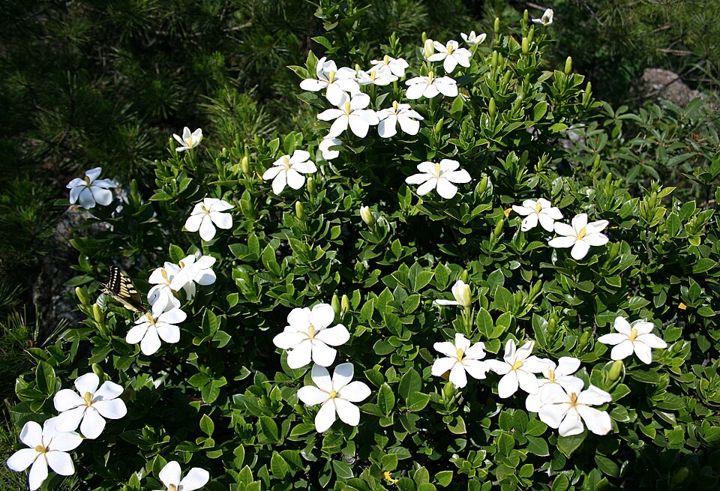
An evergreen shrub 30 cm to 3 m tall in the wild with very dense branches and a rounded habit; opposite leaves (rarely in threes), lanceolate-oblong to obovate, 3–25 cm, leathery, dark green, shiny and slightly waxy with prominent veins. Solitary terminal white flowers with a matte, porcelain-like texture, salver-shaped, intensely fragrant; garden forms are mostly double. The orange-yellow fruit has six wing-like ridges and was once a yellow dye. One of the seven fragrant flowers of Chinese tradition.
Habitat
Hillside scrub and open woodland by streams, and widely grown in gardens, parks and on balconies; in Han times planted mainly for dye as a valued crop.
Distribution
Native to the subtropical and northern tropical Far East; very common wild and cultivated in the provinces south of the Yangtze, common from Honshu south in Japan, and grown as an ornamental in Singapore.
Season and behaviour
Peak bloom from May to July, from April in the south; the flowers open pure white and turn yellow after two or three days before fading. Scent strongest at dusk and at night.
Photography tips
These are the FilmAnalysis editors' notes, not content from the sources.
The flower's texture is porcelain and has depth only in diffuse light, going dead white in sun; half a stop to a stop under, metered on the petals. The dark glossy leaves are a natural dark background. Freshly opened flowers are whitest, best with dew at dawn; an ageing yellowed flower beside a new one shows time passing.
Photographic styles
Flowers like matte white porcelain; empty space among dark leaves.
Similar species
Gardenia stenophylla (narrow leaves, small flowers); Arabian jasmine (far smaller flowers, compound leaves); white camellia (glossy petals, different shape).
Related badge
None yet. No validated photo recognition exists for this species, so no badge is tied to it: a name in the encyclopedia is not evidence in a photograph.
The illustration is original FilmAnalysis artwork. The photograph is from Wikimedia Commons; its licence and author are under it.
Why it is listed: this species comes from the Flower checklist (GBIF backbone and Wikidata verified). Names follow the GBIF backbone and Wikidata; the facts follow the sources below; photo recognition is not offered.