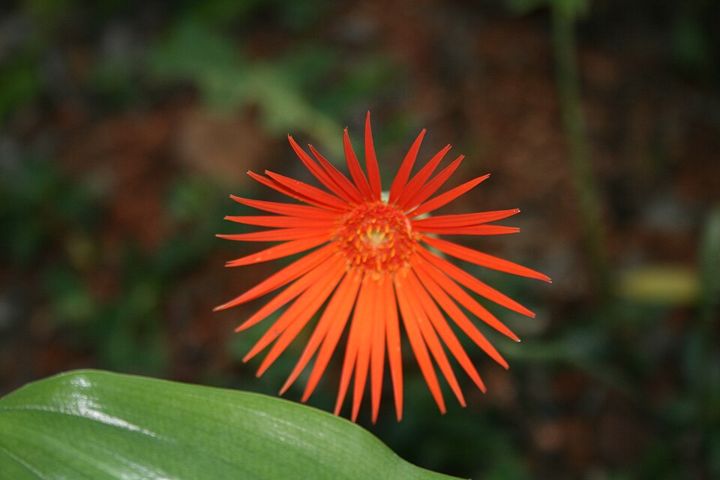
Photo: Rooivos, via Wikimedia Commons, public domain / CC0. Unmodified apart from resizing.
Colour
orange, red, yellow, pink, white
Region
Japan and temperate East Asia, Singapore and tropical Asia
Season
year-round, autumn
Shape
single flower
Identification
A tufted perennial with naked flowering scapes up to 75 cm. Stalked deeply wavy or lobed leaves 15–42 by 4–14 cm in a rosette. Spectacular heads, 4–5 cm across in the wild with orange-red rays (rarely yellow, orange, white or pink), far larger in cultivars in red, white, yellow, orange and purple, semi-double and double. Seeds with a pappus of bristles, wind-borne. First described by Hooker in Curtis's Botanical Magazine in 1889, the first Gerbera to be scientifically described. One of the five great cut flowers of the world.
Habitat
Rocky slopes in woodland at 500–1,670 m in its homeland, usually in some shade under bushes and trees; mass-produced under glass as a cut flower, also in beds and pots.
Distribution
Endemic to north-eastern South Africa (Mpumalanga, Limpopo) and Eswatini, introduced to Latin America, equatorial Africa and South-East Asia; Guangdong, Yunnan and Taiwan are commercial producers and it is in florists everywhere in China, common in Japanese beds and florists (gābera), in Singapore's florists and beds.
Season and behaviour
September to December at home; glasshouse cut flowers all year; outdoor beds in spring and autumn.
Photography tips
These are the FilmAnalysis editors' notes, not content from the sources.
Its standard portrait is straight down: radiating rays and concentric disc, with the macro focused on the ring of disc florets just opening. Half a stop to a stop under for orange-red in sun. The arc of the long scape becomes a silhouette in side backlight. A cut stem on a plain background is a minimal still life and one of the easiest flowers to photograph well.
Photographic styles
Radiating rays from above; a minimal cut flower on plain colour.
Similar species
Other Gerbera (small-flowered relatives); Shasta daisy (white rays, yellow disc, different leaves); large-flowered tickseed (all yellow).
Related badge
None yet. No validated photo recognition exists for this species, so no badge is tied to it: a name in the encyclopedia is not evidence in a photograph.
The illustration is original FilmAnalysis artwork. The photograph is from Wikimedia Commons; its licence and author are under it.
Why it is listed: this species comes from the Flower checklist (GBIF backbone and Wikidata verified). Names follow the GBIF backbone and Wikidata; the facts follow the sources below; photo recognition is not offered.