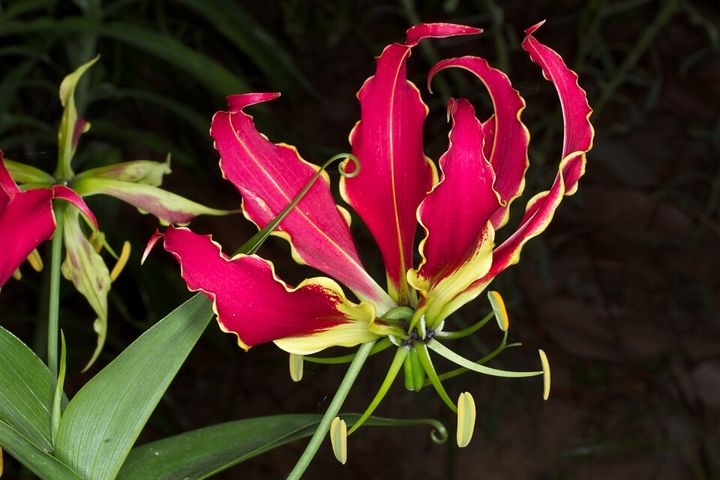
A perennial from a fleshy horizontal white rhizome, the thin stem 3–4 m in climbing plants and shorter in erect ones. Unlike its lily relatives, the leaf tips extend into green tendrils 5–8 cm long for holding on. Alternate or opposite lance-shaped to elongated oval leaves 10–13 cm. Large solitary flowers 7.6–12 cm long, the six tepals strongly reflexed upward with wavy margins, yellow at the base and flame red at the tips (also all yellow or all red), the stamens spreading outward, like a flame or a crown, hence flame lily and gloriosa lily. The whole plant, the rhizome above all, contains colchicine and is deadly poisonous. The national flower of Zimbabwe and the state flower of Tamil Nadu.
Habitat
Tropical scrub, forest edge, sand and hedges, climbing over other plants; grown as a cut flower and garden climber and naturalised in places.
Distribution
Native to Africa except the north, South Asia, South-East Asia and south-central China (Yunnan), introduced to the Americas, Australia and the Pacific islands; grown in Singapore's gardens, wild in southern Yunnan and grown in southern China, grown as a premium cut flower in Japan (gloriosa, kitsune-yuri).
Season and behaviour
June to October in the rains, July to September in southern China; cut flowers all year. A flower lasts a week and shades from yellow to red as it ages.
Photography tips
These are the FilmAnalysis editors' notes, not content from the sources.
The upswept reflexed tepals are the whole shape, and only a side view at eye level or slightly below shows the flame; a dark background makes the red and yellow leap out, with a macro for the spread stamens and wavy edges. Red saturates under cloud, half a stop under in sun. Deadly poisonous: wash your hands and keep children away.
Photographic styles
Flame-like reflexed flowers; red and yellow before a dark background.
Similar species
Other Gloriosa (most now sunk into this species); tiger lily, Lilium lancifolium (reflexed but nodding, orange and spotted, no tendrils); Lilium speciosum (reflexed, pink).
Related badge
None yet. No validated photo recognition exists for this species, so no badge is tied to it: a name in the encyclopedia is not evidence in a photograph.
The illustration is original FilmAnalysis artwork. The photograph is from Wikimedia Commons; its licence and author are under it.
Why it is listed: this species comes from the Flower checklist (GBIF backbone and Wikidata verified). Names follow the GBIF backbone and Wikidata; the facts follow the sources below; photo recognition is not offered.