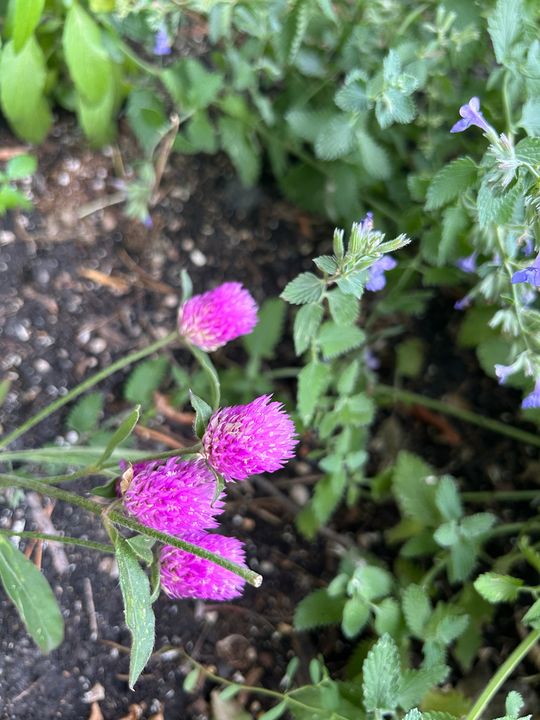
Photo: Andrea Kroeker, via iNaturalist, public domain / CC0. Unmodified apart from resizing.
Colour
purple, pink, white, red
Region
Singapore and tropical Asia, Japan and temperate East Asia
Season
summer, autumn
Shape
single flower
Identification
An erect branching annual with opposite hairy leaves. The globular flower heads are the whole show, magenta, purple, red, orange, white, pink or lilac, about 2 cm across; the true flowers are tiny and hidden among dry papery bracts, so the heads keep their colour when dried, hence the Chinese name red for a thousand days. Its flower language is unchanging love. Edible, and made into tea.
Habitat
Beds, borders, roadsides and gardens in sun, heat- and drought-tolerant; flowers all year in the tropics.
Distribution
Native to Central America (around Panama and Guatemala) and now grown worldwide; common in beds across China, grown as a summer annual in Japan (sennichikō), and common in Singapore's beds.
Season and behaviour
June to October, all year in the tropics; the heads last weeks and stay on the stems after autumn.
Photography tips
These are the FilmAnalysis editors' notes, not content from the sources.
The globular heads are like small bulbs, the papery bracts glowing against the light; a head-on macro for the bract arrangement, side light for the roundness. Magenta bleeds in direct sun, half a stop under. A bed of them compresses with a long lens into a pattern of coloured dots.
Photographic styles
Patterns of coloured balls; bracts glowing against the light.
Similar species
Gomphrena haageana (larger red heads on longer stalks); white clover (white heads, not papery).
Related badge
None yet. No validated photo recognition exists for this species, so no badge is tied to it: a name in the encyclopedia is not evidence in a photograph.
The illustration is original FilmAnalysis artwork. The photograph is from iNaturalist; its licence and author are under it.
Why it is listed: this species comes from the Flower checklist (GBIF backbone and Wikidata verified). Names follow the GBIF backbone and Wikidata; the facts follow the sources below; photo recognition is not offered.