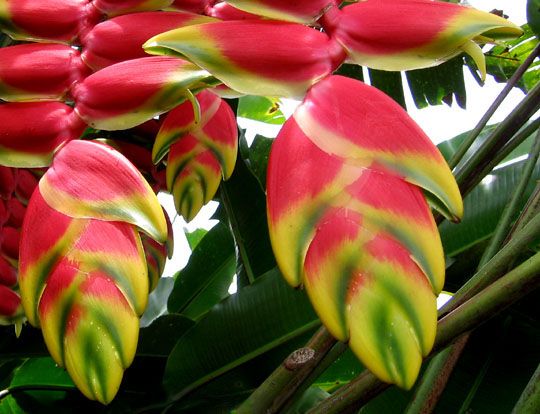
A rhizomatous perennial with banana-like leaves in clumps 1.5–3 m tall. Unlike most heliconias, whose inflorescences stand upright, its inflorescences hang, up to a metre long, a row of bright red boat-shaped bracts tipped yellow-green in two alternating ranks like a string of lobster claws or parrots' beaks, hence hanging lobster claw and false bird of paradise; the true flowers small and yellow-green inside the bracts. Waxy bracts lasting weeks.
Habitat
Rainforest edge and damp places in heat and humidity; one of the commonest flowering plants of tropical parks and resorts, also a cut flower.
Distribution
Native to the Amazon basin of South America (Peru, Bolivia, Colombia, Venezuela, Ecuador) and Central America (El Salvador, Costa Rica), naturalised in Puerto Rico and grown throughout the tropics; very common in Singapore's parks and botanic gardens, grown in southern China (Xishuangbanna in Yunnan, Guangdong, Hainan), glasshouse-only in Japan.
Season and behaviour
All year in the tropics, most in the rains; one inflorescence lasts over a month.
Photography tips
These are the FilmAnalysis editors' notes, not content from the sources.
The hanging red and yellow string is a ready vertical line, in a portrait frame at eye level with dark green leaves behind; the waxy bracts flare, so side light for texture and soft light for colour, half a stop under for red. Against the light the yellow-green edges glow. Macro for the small flowers hidden in the bracts. Sunbirds, and hummingbirds in its homeland, visit at 1/1600 s.
Photographic styles
A hanging red string before dark green; waxy bracts in side light.
Similar species
Parrot heliconia, Heliconia psittacorum (upright, small, orange); Heliconia bihai (upright); traveller's palm and bird of paradise (differently shaped inflorescences).
Related badge
None yet. No validated photo recognition exists for this species, so no badge is tied to it: a name in the encyclopedia is not evidence in a photograph.
The illustration is original FilmAnalysis artwork. The photograph is from Wikimedia Commons; its licence and author are under it.
Why it is listed: this species comes from the Flower checklist (GBIF backbone and Wikidata verified). Names follow the GBIF backbone and Wikidata; the facts follow the sources below; photo recognition is not offered.