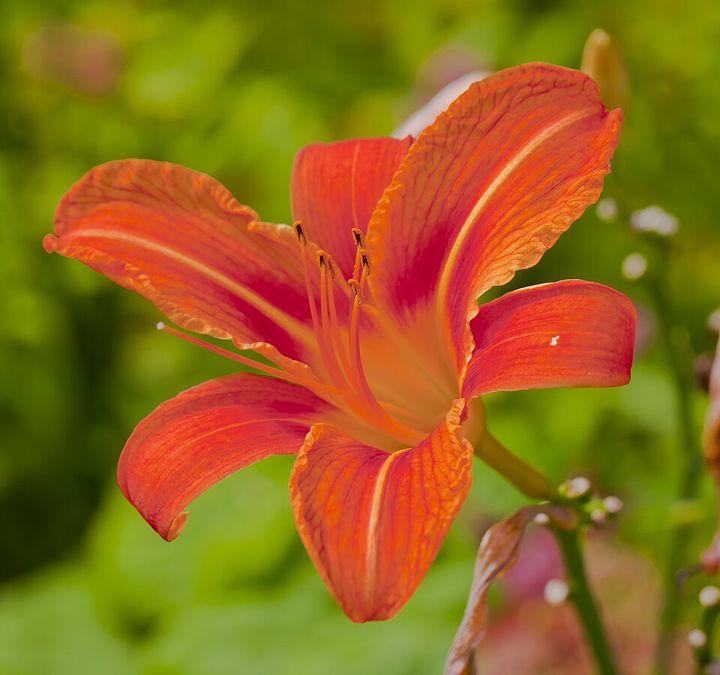
A herbaceous perennial from tuberous roots with scapes 40–150 cm tall; linear basal leaves 0.5–1.5 m long and 1.5–3 cm wide in clumps. Flowers 5–12 cm across, orange-red with a pale central line on each tepal; ten to twenty per scape, opening in succession, each lasting a single day. A three-valved capsule. Diploid and triploid forms occur in the wild, but most cultivated plants are sterile triploids spreading by stolons. Not a true lily. In China the traditional mother's flower, the word for its hall standing for one's mother; the ancient herb of forgetting sorrow.
Habitat
Hillsides, roadsides, ditches and gardens, extremely adaptable, escaped in North America as the ditch lily; the edible golden needle is a related species.
Distribution
Native to China, Siberia, Japan and South-East Asia, brought to Taiwan from southern China in 1661; common throughout China and Japan. Absent from Singapore.
Season and behaviour
June to August, peaking in July in the north; each flower opens in the morning and fades by night, replaced the next day.
Photography tips
These are the FilmAnalysis editors' notes, not content from the sources.
Orange-red bleeds in sun, so underexpose a little or shoot under cloud; backlight shows the veins and pale midline through the tepals. The flower is large, so a medium lens head-on for the depth of the trumpet and macro for the stamens. Roadside clumps of orange against green compress with a long lens. Around Mother's Day it carries a cultural meaning.
Photographic styles
The depth of an orange trumpet seen head-on; roadside summer colour.
Similar species
Hemerocallis citrina (yellow, slimmer, opening in the evening); Hemerocallis lilioasphodelus (yellow, northern); tiger lily and true lilies (recurved or spotted tepals, leaves on the stem).
Related badge
None yet. No validated photo recognition exists for this species, so no badge is tied to it: a name in the encyclopedia is not evidence in a photograph.
The illustration is original FilmAnalysis artwork. The photograph is from Wikimedia Commons; its licence and author are under it.
Why it is listed: this species comes from the Flower checklist (GBIF backbone and Wikidata verified). Names follow the GBIF backbone and Wikidata; the facts follow the sources below; photo recognition is not offered.