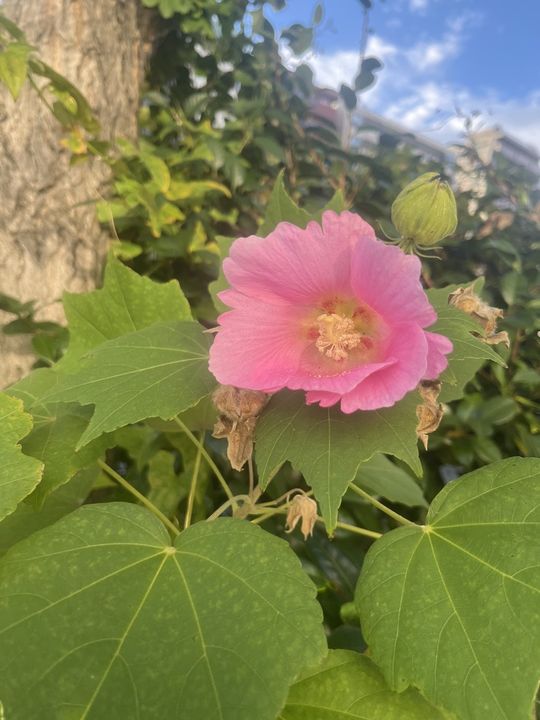
Photo: Awhesian, via iNaturalist, public domain / CC0. Unmodified apart from resizing.
Colour
white, pink, red
Region
Japan and temperate East Asia, Singapore and tropical Asia
Season
autumn
Shape
large head
Identification
A semi-deciduous large shrub or small tree, 3.7–4.6 m with a woody trunk where it never freezes, more often a bushy 1.5–1.8 m. Palmately lobed leaves, the stems and petioles densely covered in stellate and glandular hairs. Large flowers 10–15 cm across, single or double, opening white or pink in the morning and turning deep red by evening, three changes in a day, hence the Chinese name drunken hibiscus; single flowers are cup-shaped. A mallow, not a rose.
Habitat
Gardens, waterside, roadsides and hillsides; Chengdu planted it everywhere in the Song dynasty and became the hibiscus city. Sun-loving and tolerant of wet ground.
Distribution
Native to southern China, now grown on every continent except Antarctica; very common south of the Yangtze and the city flower of Chengdu; cultivated from Honshu south in Japan (fuyō) and occasionally in Singapore.
Season and behaviour
August to November, one of the flowers of autumn; a single bush carries the morning's white flowers beside yesterday's reddened ones.
Photography tips
These are the FilmAnalysis editors' notes, not content from the sources.
The colour change through the day is the subject: shoot the same flower morning, noon and evening. The big flower suits a medium lens, and soft light gives the finest white-pink-red gradations; backlight shows the veins through thin petals. Cotton roses by water with their reflection is the traditional composition, and Chengdu's river banks are the ready location.
Photographic styles
A large flower changing three times a day; autumn colour by the water.
Similar species
Chinese hibiscus (red, all year, long projecting staminal column); rose of Sharon (smaller summer flowers, lilac or white); swamp rose mallow (herbaceous, larger flowers, North America).
Related badge
None yet. No validated photo recognition exists for this species, so no badge is tied to it: a name in the encyclopedia is not evidence in a photograph.
The illustration is original FilmAnalysis artwork. The photograph is from iNaturalist; its licence and author are under it.
Why it is listed: this species comes from the Flower checklist (GBIF backbone and Wikidata verified). Names follow the GBIF backbone and Wikidata; the facts follow the sources below; photo recognition is not offered.