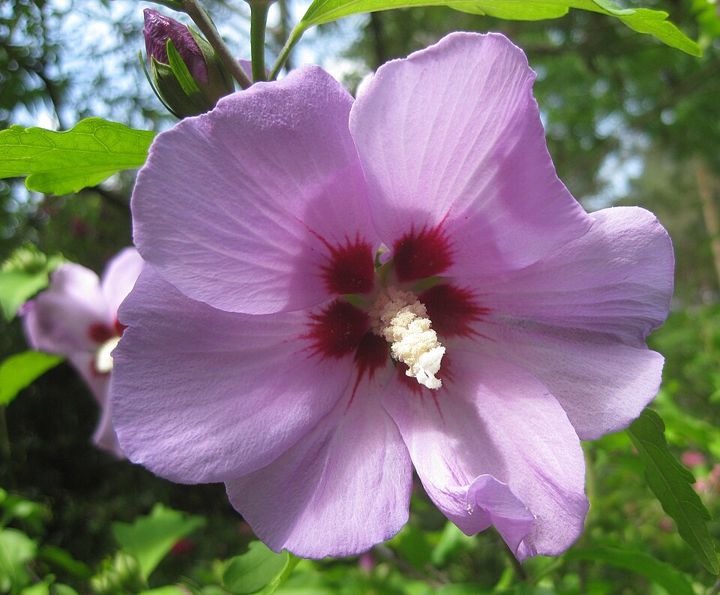
A hardy deciduous shrub, upright and vase-shaped, 2–4 m tall. Rhombic-ovate leaves with three shallow lobes. Large trumpet flowers with a prominent white staminal column tipped yellow; often pink, also dark pink near purple, light pink or white, usually with a deep red eye. Each flower lasts a day, but buds on the new growth keep the shrub flowering all summer. Called the endless flower in Korea, whose national flower it is, appearing on the emblem and in the anthem. Tolerant of pollution, heat, poor soil and drought.
Habitat
Gardens, hedges, parks, roadsides and temples, one of the commonest summer flowering hedges, self-seeding freely and almost naturalised in suburbs.
Distribution
Native to East Asia in south-central and south-eastern China, introduced across Asia, Europe and North America; the epithet comes from Syrian gardens where it was collected. Common throughout China and Japan; absent from Singapore.
Season and behaviour
July to October, most in high summer; each flower opens at dawn and fades by evening, so photograph in the morning.
Photography tips
These are the FilmAnalysis editors' notes, not content from the sources.
The projecting staminal column is the axis of the composition, in a side macro; the depth of the trumpet from the front with a medium lens, the deep red eye as focus. Pink bleaches at noon and is truest in the morning. In a long hedge pick one stretch with fresh flowers and buds with a long lens. The one-day life can be shot as a sequence.
Photographic styles
Pink-purple trumpets in a summer hedge; the axis of a staminal column.
Similar species
Cotton rose (larger flowers changing three times a day, autumn); Chinese hibiscus (red, evergreen, tropical); double hibiscus cultivars.
Related badge
None yet. No validated photo recognition exists for this species, so no badge is tied to it: a name in the encyclopedia is not evidence in a photograph.
The illustration is original FilmAnalysis artwork. The photograph is from Wikimedia Commons; its licence and author are under it.
Why it is listed: this species comes from the Flower checklist (GBIF backbone and Wikidata verified). Names follow the GBIF backbone and Wikidata; the facts follow the sources below; photo recognition is not offered.