Japan and temperate East Asia, Singapore and tropical Asia
Season
summer
Shape
cluster
Identification
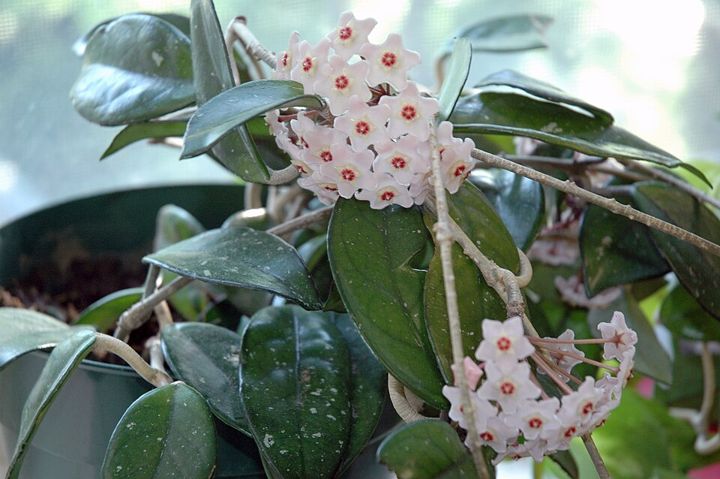
A twining climber with faintly succulent, smooth, pale grey young shoots. Perennial leaves broadly oval to long-oval or heart-shaped, slightly succulent with a waxy glossy surface, 3–5 cm wide and 3.5–13 cm long. Many flowers in a hemispherical umbel like a pompon, each a five-pointed star that looks made of porcelain, white to pale pink with a dark red corona, sweetly scented and dripping nectar at night. Spindle-shaped fruit 6–10 cm. Called an orchid in Chinese but not one. In cultivation for over two hundred years with many cultivars.
Habitat
Climbing trunks and rocks in forest, and very common as a house plant in pots and hanging baskets; likes bright diffuse light.
Distribution
Native to southern China (including Hainan), Taiwan, Laos and Japan (including the Ryukyus); wild in the hill forests of southern China and Taiwan, in southern Kyushu and the Ryukyus, and common as a cultivated plant in Singapore. Holder of the RHS Award of Garden Merit.
Season and behaviour
May to August, each umbel lasting a week or two and the same spur flowering year after year (so never cut the spurs off); scent and nectar drops are strongest in the evening.
Photography tips
These are the FilmAnalysis editors' notes, not content from the sources.
The porcelain stars want a head-on macro with the dark red corona as focus; soft light makes the texture most like china. Nectar beading from the centre in the evening glitters against the light. The whole hemisphere at eye level becomes a pompon against a dark background. The waxy leaves reflect, so use a polariser.
Photographic styles
Macro of porcelain stars; pompon umbels.
Similar species
Other Hoya species (many, with different leaves and colours); balloon flower vine, Gymnanthera (white stars, round fruit, another genus).
Related badge
None yet. No validated photo recognition exists for this species, so no badge is tied to it: a name in the encyclopedia is not evidence in a photograph.
The illustration is original FilmAnalysis artwork. The photograph is from Wikimedia Commons; its licence and author are under it.
Why it is listed: this species comes from the Flower checklist (GBIF backbone and Wikidata verified). Names follow the GBIF backbone and Wikidata; the facts follow the sources below; photo recognition is not offered.