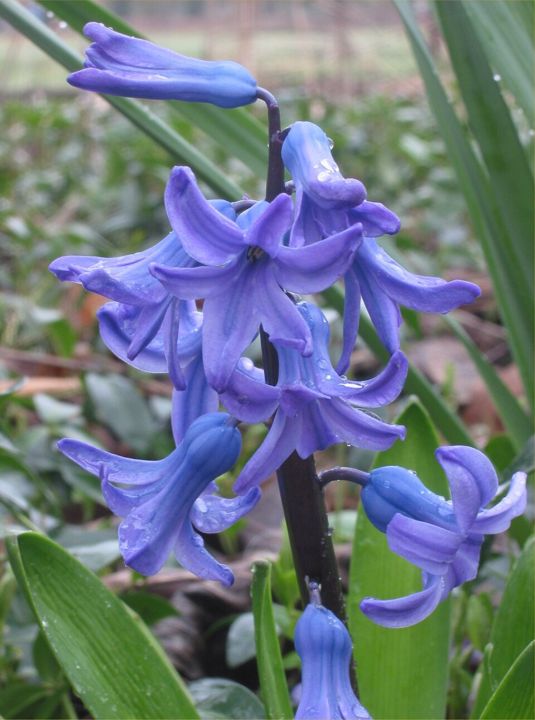
A bulb 3–7 cm across. Strap-shaped leaves 15–35 cm long and 1–3 cm broad, soft and succulent, in a basal whorl. The flowering stem is a raceme 20–35 cm (rarely 45 cm) tall with two to fifty strongly fragrant flowers 2–3.5 cm long, tubular, six-lobed and recurved; purple in the wild, blue, pink, white, yellow, red and double in cultivars. Exceptionally early, often forced for Christmas and the Spring Festival. Introduced to Europe in the sixteenth century; the Netherlands is the bulb centre. The bulb is an irritant.
Habitat
Rocky slopes and scrub in its homeland; a bulb for beds, pots and water culture.
Distribution
Native to western Asia from southern Turkey through Syria and Lebanon to northern Israel; in spring beds and water-grown pots across China, common in Japanese beds and water culture (hiyashinsu), only at flower shows in Singapore.
Season and behaviour
March and April, forced in water in January and February; a spike lasts two weeks.
Photography tips
These are the FilmAnalysis editors' notes, not content from the sources.
A dense spike wants a portrait frame, with a macro on one recurved six-lobed flower; blue and purple are truest under cloud and shift blue-violet in sun. A bulb forced in a glass with its white roots showing is its own still life, in window light with glass, roots and spike. The scent is strong, so photograph someone bending to it. Rows of colour in a bed compress with a long lens.
Photographic styles
Roots and spike in a glass; macro of a dense spike.
None yet. No validated photo recognition exists for this species, so no badge is tied to it: a name in the encyclopedia is not evidence in a photograph.
The illustration is original FilmAnalysis artwork. The photograph is from Wikimedia Commons; its licence and author are under it.
Why it is listed: this species comes from the Flower checklist (GBIF backbone and Wikidata verified). Names follow the GBIF backbone and Wikidata; the facts follow the sources below; photo recognition is not offered.