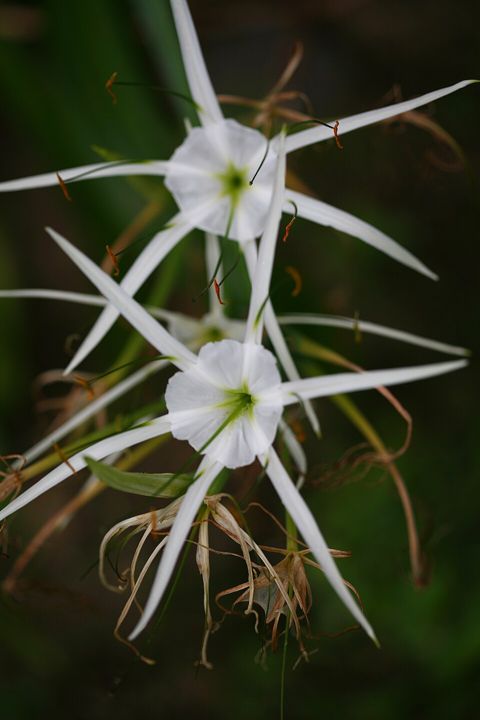
A bulbous perennial 60–70 cm tall with a bulb 7–10 cm across that develops a neck with age. Large white stalkless vanilla-scented flowers; six slender recurved tepals joined at the centre by a membranous cup formed from the stamen bases (the staminal cup, the genus name meaning beautiful membrane), like a spider, hence spider lily and the Chinese water-ghost banana; the flower tube 14–17 cm or longer. Succulent seeds up to ninety percent water.
Habitat
Behind beaches, on river banks and in wetlands, highly tolerant of salt and wet; widely planted as groundcover and in beds in tropical cities.
Distribution
Native to the warm coasts of Latin America (Mexico to Peru and northern Brazil); naturalised in Hainan, South-East Asia, India and southern Africa and widely grown in the tropics. Very common on Singapore's roadsides and in its parks, grown in southern China, grown in Okinawa.
Season and behaviour
Flowers on and off all year in the tropics, in flushes after rain; each flower lasts a day or two, opening in the evening with the scent strongest at night.
Photography tips
These are the FilmAnalysis editors' notes, not content from the sources.
The spider shape shows only in a side or head-on macro that catches the membranous cup and slender tepals; a dark background and side backlight make the white lines glow, half a stop to a stop under. Freshly opened evening flowers stand straightest. Whole clumps of umbels at eye level as a group. Often confused with crinums: the staminal cup is the difference.
Photographic styles
The lines of white spider flowers; freshly opened evening flowers.
Similar species
Crinum lily (recurved tepals but no membranous cup between the stamens); Hymenocallis speciosa (larger flowers, broader leaves); shui gui jiao is this species' formal Chinese name.
Related badge
None yet. No validated photo recognition exists for this species, so no badge is tied to it: a name in the encyclopedia is not evidence in a photograph.
The illustration is original FilmAnalysis artwork. The photograph is from Wikimedia Commons; its licence and author are under it.
Why it is listed: this species comes from the Flower checklist (GBIF backbone and Wikidata verified). Names follow the GBIF backbone and Wikidata; the facts follow the sources below; photo recognition is not offered.