Japan and temperate East Asia, Singapore and tropical Asia
Season
summer, autumn
Shape
trumpet
Identification
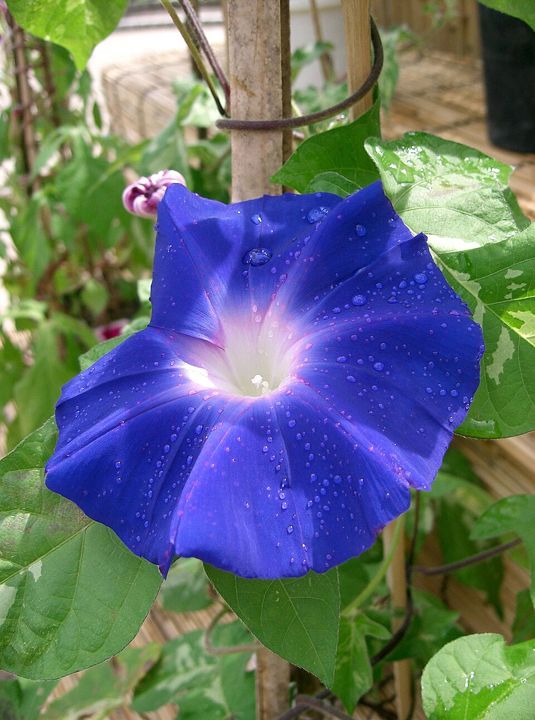
A climber with twining stems up to 5 m, densely to sparsely covered in long hairs. Finely hairy emerald-green leaves, ovate to almost circular, 5–14 cm, heart-shaped at the base, entire or three- to five-lobed with pointed lobes. Showy funnel flowers, in wild forms almost always blue to reddish purple with a whitish tube and smaller than cultivated ones; the cultivated asagao of Japan comes in a huge range bred since the Edo period. They open in the morning and close by afternoon. Long, spiny-haired sepals. Very like Ipomoea hederacea.
Habitat
Fences, walls, roadsides, waste ground and gardens, self-seeding freely; in Japan the summer garden flower and the schoolchild's observation plant, with a morning-glory fair at Iriya in Tokyo.
Distribution
Native to Central America and Mexico, not Japan, and introduced widely across the world; escaped and grown throughout China, grown throughout Japan (asagao, brought in the Nara period as a medicine), naturalised in Singapore.
Season and behaviour
July to October, opening at four or five in the morning and starting to close after ten, so rise early; it closes sooner on sunny days than cloudy ones.
Photography tips
These are the FilmAnalysis editors' notes, not content from the sources.
Six to seven in the morning is the whole window: the blue saturates in soft morning light and backlight shows the radiating white stripes through the corolla. Straight down for the five-pointed star of the funnel, from the side for the white-to-blue gradient of the tube. A string of flowers on a fence with dew and a spider's web is the standard summer-morning picture.
Photographic styles
Blue trumpets on a summer morning; fences and dew.
Similar species
Ipomoea purpurea (round unlobed leaves, short sepals); Ipomoea hederacea (near-identical, long recurved sepals); Ipomoea tricolor (sky blue, larger flowers).
Related badge
None yet. No validated photo recognition exists for this species, so no badge is tied to it: a name in the encyclopedia is not evidence in a photograph.
The illustration is original FilmAnalysis artwork. The photograph is from Wikimedia Commons; its licence and author are under it.
Why it is listed: this species comes from the Flower checklist (GBIF backbone and Wikidata verified). Names follow the GBIF backbone and Wikidata; the facts follow the sources below; photo recognition is not offered.