Japan and temperate East Asia, Singapore and tropical Asia
Season
summer, autumn
Shape
trumpet
Identification
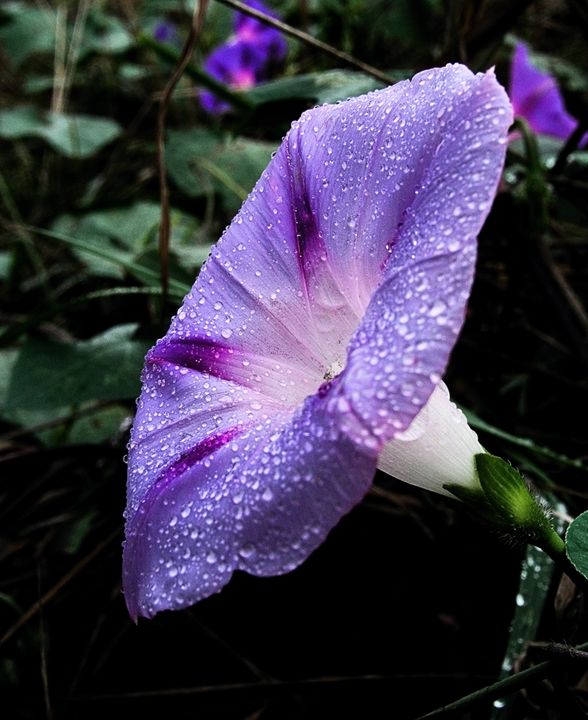
A twining herb climbing 2–3 m on any support, the stems covered in brown hairs. Heart-shaped unlobed leaves (unlike the three-lobed Ipomoea nil). Trumpet flowers predominantly blue to purple or white, 3–6 cm across; the epithet means purple. Many cultivars, such as 'Grandpa Ott's' (deep purple with a red star) and 'Crimson Rambler' (red-violet with a white throat). Opens in the morning and closes by afternoon.
Habitat
Field edges, roadsides, house surroundings, fences and valley woodland, preferring moist rich soil but growing on almost any; often a noxious weed, also grown for ornament.
Distribution
Native to Mexico and Central America and naturalised through the warm temperate and subtropical world; found and grown over most of China to 2,800 m, common throughout Japan (maruba-asagao), naturalised in Singapore.
Season and behaviour
June to October, opening at dawn and closing during the morning, so shoot within two hours of sunrise.
Photography tips
These are the FilmAnalysis editors' notes, not content from the sources.
Round heart-shaped leaves in the frame with the trumpet are what separate it from Ipomoea nil; against early light the corolla shows radiating white lines, and the blue-purple saturates in soft light. Straight down for the five-pointed star of the funnel; a string on a fence with a long lens. Dew and spider webs are standard summer-morning equipment.
Photographic styles
Purple trumpets on a summer-morning fence; the round of a heart-shaped leaf.
Similar species
Ipomoea nil (three-lobed leaves, long bristly sepals); Ipomoea tricolor (sky blue, larger); cypress vine (finely cut leaves, small red flowers).
Related badge
None yet. No validated photo recognition exists for this species, so no badge is tied to it: a name in the encyclopedia is not evidence in a photograph.
The illustration is original FilmAnalysis artwork. The photograph is from Wikimedia Commons; its licence and author are under it.
Why it is listed: this species comes from the Flower checklist (GBIF backbone and Wikidata verified). Names follow the GBIF backbone and Wikidata; the facts follow the sources below; photo recognition is not offered.