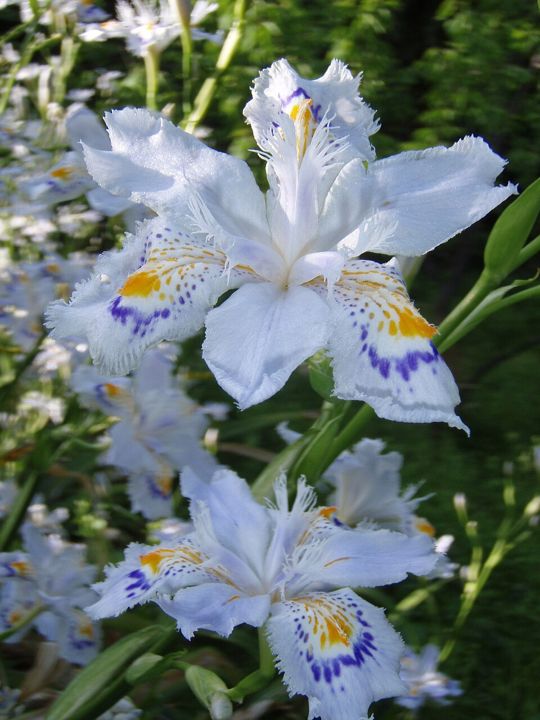
A rhizomatous perennial with short, slender, greenish creeping rhizomes that send out long wiry stolons, shallow-rooted and forming dense carpets. Basal leaves deep to yellowish green, glossy on one side and dull on the other, tinted reddish purple near the rhizome, without a midvein, sword-shaped, 25–60 cm tall, in a broad evergreen fan. Wiry stout stems 25–80 cm with 5–12 short branches near the top; flowers pale blue, lavender or white with finely fringed petal edges and an orange or yellow crest with purple spots on the falls, like butterflies settled on the leaves.
Habitat
Woodland floor, forest edge, streamsides and moist slopes, best in half shade; widely planted in gardens, and as shaga common in Japanese temple grounds.
Distribution
Native to China and Japan; common in the hills of the Yangtze basin and southward and from Honshu south in Japan, where it is thought to have been introduced from China long ago and naturalised. Absent from Singapore.
Season and behaviour
April and May, each flower lasting a day but the stems opening flowers in succession for three or four weeks.
Photography tips
These are the FilmAnalysis editors' notes, not content from the sources.
Small and intricate, so a head-on macro for the fringed edge and orange crest; the pale blue is truest in overcast diffuse light and goes almost white in sun. Its half-shaded woodland is exactly soft light; a wide aperture turns the sword leaves behind into green stripes.
Photographic styles
Pale blue butterflies on the forest floor; macro of fringed petals.
Similar species
Iris confusa (leaves at the top of a stem rather than at ground level, south-west); Iris tectorum (larger blue-violet flowers, no fringe); the name Japanese iris usually means Iris ensata.
Related badge
None yet. No validated photo recognition exists for this species, so no badge is tied to it: a name in the encyclopedia is not evidence in a photograph.
The illustration is original FilmAnalysis artwork. The photograph is from Wikimedia Commons; its licence and author are under it.
Why it is listed: this species comes from the Flower checklist (GBIF backbone and Wikidata verified). Names follow the GBIF backbone and Wikidata; the facts follow the sources below; photo recognition is not offered.