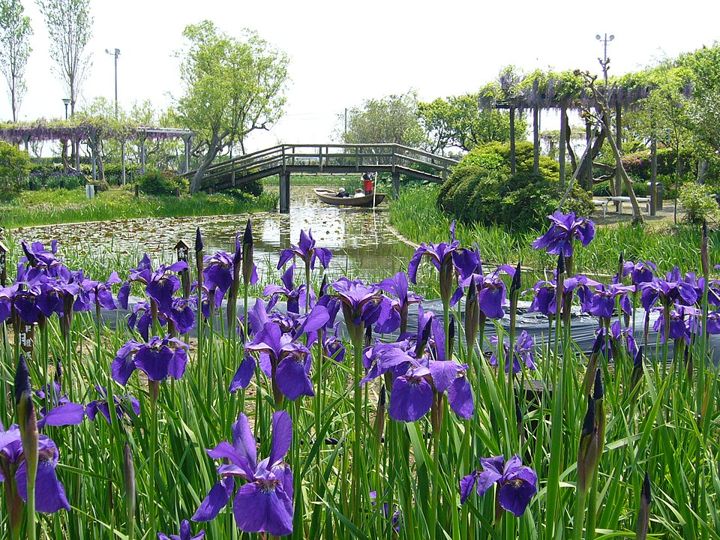
A thick creeping rhizome. Grey-green linear narrow leaves 20–60 cm long and 5–13 mm wide, about the height of the flowering stems but drooping so they look shorter. Hollow unbranched stems 30–90 cm with two or three flowers at the top; three green spathes reddish at the base (hence the epithet blood-red). Flowers 6–8 cm across in red-purple to blue-purple shades, rarely white, the three large falls with a white signal veined purple at the base and three upright inner petals. In the Siberian iris series.
Habitat
Marshes, wet meadows and sunny damp slopes at 300–1,900 m; also grown in temperate gardens. In Japan it is ayame, one of the three irises of the early-summer festival with hanashōbu and kakitsubata.
Distribution
Native to Russia, Mongolia, north-east China (Jilin, Liaoning, Inner Mongolia, Heilongjiang), Korea and Japan; common throughout Japan, the true ayame; common in the meadows of north-east China. Absent from Singapore.
Season and behaviour
May to July, mid-May to early June in Japan; before hanashōbu and slightly after kakitsubata.
Photography tips
These are the FilmAnalysis editors' notes, not content from the sources.
The white network at the base of the falls separates it from hanashōbu (yellow signal) and kakitsubata (white stripe), so a head-on macro; blue-purple is truest under cloud. The slender grey-green leaves and upright stems suit a portrait frame against the dark green of wet meadow. Best beaded with rain.
Photographic styles
Blue-purple irises on a wet meadow; macro of the veined falls.
Similar species
Iris ensata (yellow signal at the base of the falls, leaves with a midrib, June–July, grown by water); Iris laevigata (white stripe on the falls, growing in water); Siberian iris (branched stems, Europe).
Related badge
None yet. No validated photo recognition exists for this species, so no badge is tied to it: a name in the encyclopedia is not evidence in a photograph.
The illustration is original FilmAnalysis artwork. The photograph is from Wikimedia Commons; its licence and author are under it.
Why it is listed: this species comes from the Flower checklist (GBIF backbone and Wikidata verified). Names follow the GBIF backbone and Wikidata; the facts follow the sources below; photo recognition is not offered.