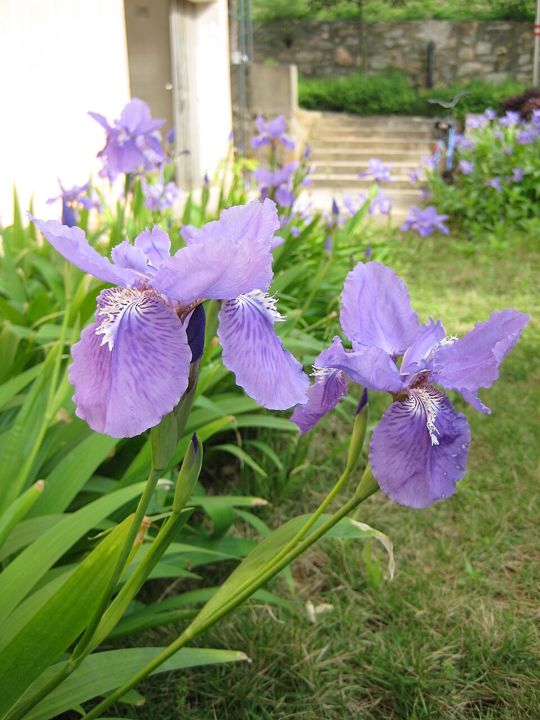
A thumb-thick creeping rhizome, buff or greenish, forming spreading clumps. Basal fans of yellowish to pale green sword-shaped leaves, glossy and ribbed, 15–60 cm long and 1.5–5 cm wide, floppy and semi-evergreen. Cylindrical stems 20–45 cm with one or two branches; flowers lavender-blue, blue-violet or sky blue, also a white form, the falls carrying a white crest spotted purple and white veining. In Japan it was planted along the ridges of thatched roofs to bind them, hence roof iris (ichihatsu).
Habitat
Forest edge, hill grassland, streamsides and damp roadsides, and very common in garden and park borders and at the foot of walls.
Distribution
Native to China (centre, south-west and north), Korea and Myanmar; very common wild and cultivated across China, the species the Chinese word yuanwei really means; widely grown in Japan after introduction (the roof tradition now rare). Absent from Singapore.
Season and behaviour
April and May, a month before the Japanese iris and together with the wisteria; each flower lasts two or three days.
Photography tips
These are the FilmAnalysis editors' notes, not content from the sources.
The white crest and purple spots on the falls are the macro point, from the front and slightly above; blue-violet is truest under cloud and at dawn. The fan of sword leaves and the stem suit a portrait frame against a dark background. In a flowering clump, a wide aperture picks one flower and turns the rest into blue dots.
Photographic styles
Blue-violet irises at a garden wall; macro of the crest.
Similar species
Fringed iris, Iris japonica (small pale blue fringed flowers); bearded iris (garden hybrid, bearded rather than crested falls, larger); blood iris and Japanese iris (no crest, in wetlands).
Related badge
None yet. No validated photo recognition exists for this species, so no badge is tied to it: a name in the encyclopedia is not evidence in a photograph.
The illustration is original FilmAnalysis artwork. The photograph is from Wikimedia Commons; its licence and author are under it.
Why it is listed: this species comes from the Flower checklist (GBIF backbone and Wikidata verified). Names follow the GBIF backbone and Wikidata; the facts follow the sources below; photo recognition is not offered.