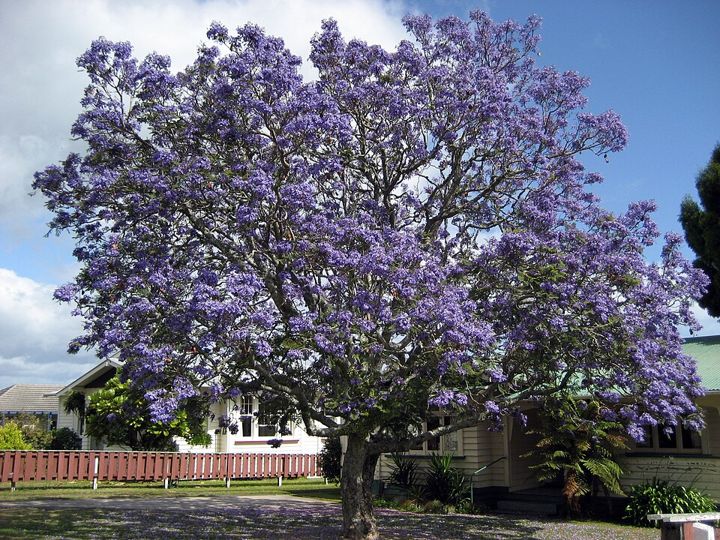
Photo: Kahuroa, via Wikimedia Commons, public domain / CC0. Unmodified apart from resizing.
Colour
blue, purple
Region
Singapore and tropical Asia, Japan and temperate East Asia
Season
spring, summer
Shape
cluster
IUCN status
Vulnerable
Identification
A subtropical tree up to 20 m, the bark thin, grey-brown and smooth when young and finely scaly later; slender slightly zigzag light reddish-brown twigs. Bipinnate leaves up to 45 cm with leaflets little over 1 cm, like a mimosa's (the epithet means mimosa-leaved), so it is planted for its foliage even where it rarely flowers. Violet-blue bell flowers up to 5 cm in panicles of 30 cm in spring and early summer, lasting up to two months, a tree of blue haze. Woody flattened round pods 5–8 cm across with many flat winged seeds. A white form exists. Assessed Vulnerable in the wild by the IUCN.
Habitat
Streets, parks and campuses of the subtropics, sun-loving and drought-tolerant, flowering best after a cool dry winter; sparse in the humid tropics.
Distribution
Native to south-central South America (north-western Argentina, Bolivia); Kunming is China's famous jacaranda city (Jiaochang Middle Road), with street trees also in Guangdong, Guangxi, Fujian, Hainan and Taiwan; a few in warm parts of Japan and under glass (jakaranda, with a festival at Nichinan in Miyazaki); grown in Singapore but flowering little.
Season and behaviour
Late April to May in Kunming, May and June in southern China, late May to June at Nichinan; over a month, the fallen flowers carpeting the ground violet.
Photography tips
These are the FilmAnalysis editors' notes, not content from the sources.
Violet-blue is the hardest colour for a sensor: cloud or early morning is truest, with white balance by hand; sun pushes it pink or blue. A whole street compresses into a violet tunnel with a long lens, and low angles take in the carpet of fallen flowers and passers-by; against blue sky the contrast is weak, so prefer a white wall or a building behind. Macro for the throat of a bell.
Photographic styles
A street like a violet tunnel; a road carpeted with fallen flowers.
Similar species
Chinaberry, Melia azedarach (small pale lilac spring flowers, different leaves); paulownia (large pale purple bells, big leaves); pink trumpet tree (pink, same family).
Related badge
None yet. No validated photo recognition exists for this species, so no badge is tied to it: a name in the encyclopedia is not evidence in a photograph.
The illustration is original FilmAnalysis artwork. The photograph is from Wikimedia Commons; its licence and author are under it.
Why it is listed: this species comes from the Flower checklist (GBIF backbone and Wikidata verified). Names follow the GBIF backbone and Wikidata; the facts follow the sources below; photo recognition is not offered.