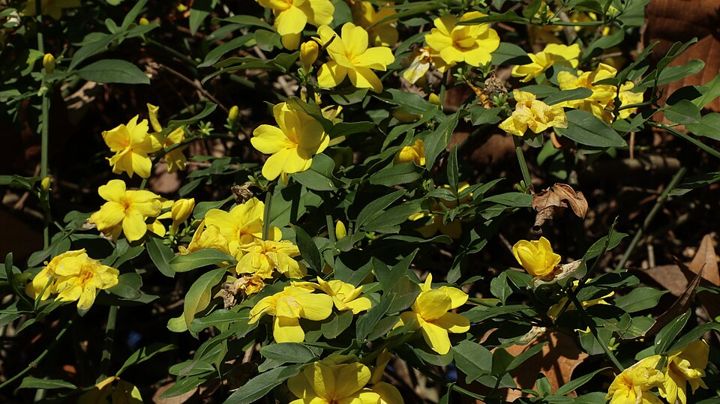
A slender deciduous shrub up to 3 m tall and wide with green, square, arching vine-like shoots. Opposite trifoliate leaves of oval-oblong dark green leaflets about 3 cm long. Solitary axillary flowers, often on the bare stems (the epithet means naked-flowered), six-lobed, bright yellow, about 1 cm across (double in some cultivars), unscented. Flowering from November to March in the northern hemisphere, among the first flowers of early spring, hence the Chinese name welcoming spring.
Habitat
Hillside scrub, cliffs and streamsides, more often trailing over banks and retaining walls in gardens and parks; hardy, drought-tolerant and rooting easily from cuttings.
Distribution
Native to China's Gansu, Shaanxi, Sichuan, Tibet and Yunnan, widely planted everywhere and seen all over northern cities in early spring; grown in Japan (ōbai) and naturalised in France and parts of the United States. Absent from Singapore.
Season and behaviour
February and March, early March in the north, slightly before forsythia and even in snow; about a month.
Photography tips
These are the FilmAnalysis editors' notes, not content from the sources.
Green shoots with yellow flowers trailing over a retaining wall are a subject of lines: a long lens along the curve of the shoots, against grey wall or dark background, the yellow truest under cloud. In snow, add a stop. Small flowers want a macro of the six-lobed corolla and green square stem. One close-up showing the differences from forsythia (six lobes, green stems, trifoliate leaves).
Photographic styles
Yellow flowers and green shoots trailing over a wall; a point of yellow in snow.
None yet. No validated photo recognition exists for this species, so no badge is tied to it: a name in the encyclopedia is not evidence in a photograph.
The illustration is original FilmAnalysis artwork. The photograph is from Wikimedia Commons; its licence and author are under it.
Why it is listed: this species comes from the Flower checklist (GBIF backbone and Wikidata verified). Names follow the GBIF backbone and Wikidata; the facts follow the sources below; photo recognition is not offered.