Singapore and tropical Asia, Japan and temperate East Asia
Season
summer
Shape
cluster
Identification
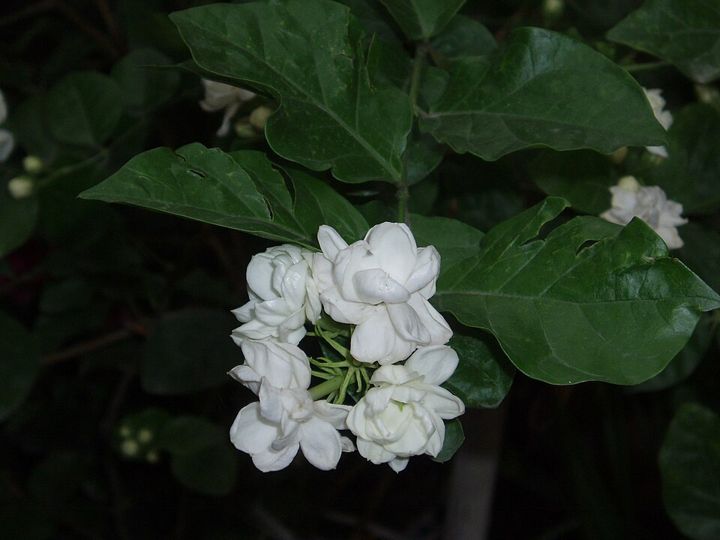
An evergreen vine or shrub 0.5–3 m tall and highly variable. Ovate leaves 4–12.5 cm, opposite or in whorls of three, simple (unlike most jasmines, which are pinnate), smooth. Flowers in clusters of three to twelve at the branch tips, white, the corolla 2–3 cm across with five to nine lobes, strongly scented; the double 'Grand Duke of Tuscany' looks like a small rose. Cultivated plants generally set no seed and are grown from cuttings. The national flower of the Philippines and one of Indonesia's; the jasmine of the Chinese folk song and of jasmine tea.
Habitat
Gardens, balconies, beds and around tea gardens, in sun, heat and moisture; grown on a large scale around Fuzhou and Hengxian for jasmine tea.
Distribution
Native to Bhutan and India and widely cultivated in West, South and South-East Asia, naturalised in many places; widely grown in southern China and as a pot plant in the north, grown in Japan (matsurika), and common in Singapore's gardens and at Hindu temples.
Season and behaviour
May to October, peaking in high summer, all year in the tropics; flowers open in the evening and are most fragrant at dawn, and tea growers pick the unopened buds at dusk.
Photography tips
These are the FilmAnalysis editors' notes, not content from the sources.
Small white flowers among dark green leaves want a cluster in soft light, half a stop under; macro for the five-to-nine-lobed corolla and spiral buds. The double form for layered petals. Freshly opened evening flowers are whitest and yellow overnight. Picking and scenting in the tea districts is a human subject: the growers' hands and bamboo baskets are worth frames.
Photographic styles
Small white flowers among dark leaves; the people of picking and tea.
None yet. No validated photo recognition exists for this species, so no badge is tied to it: a name in the encyclopedia is not evidence in a photograph.
The illustration is original FilmAnalysis artwork. The photograph is from Wikimedia Commons; its licence and author are under it.
Why it is listed: this species comes from the Flower checklist (GBIF backbone and Wikidata verified). Names follow the GBIF backbone and Wikidata; the facts follow the sources below; photo recognition is not offered.